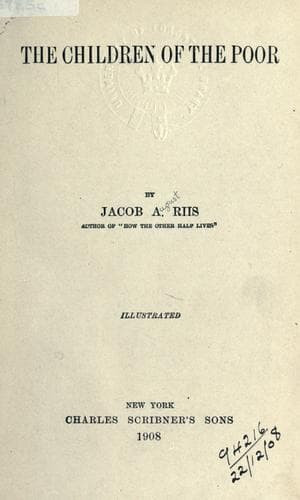
The Children of the PoorRiis, Jacob A. (Jacob August)
History
The Children of the Poor
Riis, Jacob A. (Jacob August)
Child welfare -- New York (State) -- New York; Poor; Poor -- New York (State) -- New York
private contributors." Now, it runs not only the New York house but its
Western agency as well on its income.
The city pays the bills, but exercises no other control over the
institutions. It does not even trouble itself with counting the
children.[31] The committing magistrate consults and is guided more or
less by the Officers of the Society for the Prevention of Cruelty to
Children, in his choice of the institution into which the child is put.
But both are bound by the law that imposes the "faith-test." The
faith-test, as enforced by civil law anywhere, is absurd. The parents of
the eighty per cent. of children in institutions who were not orphans,
split no theological hairs in ridding themselves of their support. Backed
by the money sacks of a great and wealthy city, it is injurious humbug.
This is not the perfection of organized charitable effort for the rescue
of the children of which I spoke, but rather the perversion of it.
It is reasonable to ask that if the public is to pay the piper, the public
should have the hiring of him too. A special city officer is needed to
have this matter in charge. Nearly six years ago Commissioner Lowell
submitted a draft for a bill creating a department for the care of
dependent children in New York City, with a commissioner at the head whose
powers would have been an effective check upon the evil tendencies of the
present law. But we travel slowly along the path of municipal reform, and
the commissioner is yet a dream. Some day we may wake up and find him
there, and then we shall be ready, by and by, to carry out the ideal plan
of placing those children, for whom free homes cannot be found, out at
board in families where they shall come by their rights, denied them by
institution life. Then, too, we shall find, I think, that there is a good
deal less of the problem than we thought. The managers of the Union
Temporary Home in Philadelphia decided, after thirty one years of work, to
close the House and put the children out to board, because experience had
convinced them that "life in the average institution is not so good for
children as life in the average home." The intelligence of the conclusion,
and the earnestness with which they presented it, guaranteed that their
"Home" had been above the average.
Public-domain text, read in full here on John Shaqi.
Reviews
Reviews
No reviews yet
Be the first to share your thoughts on this work.
Elsewhere in the archive
Join the Discussion
Join the discussion
Sign in to leave a comment or review.
Sign InorCreate an account