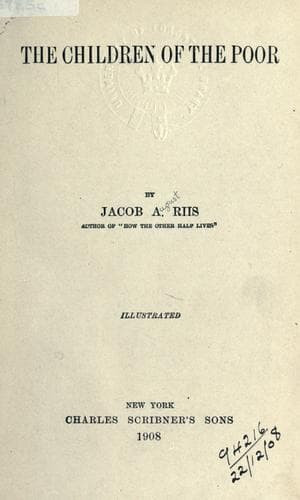
The Children of the PoorRiis, Jacob A. (Jacob August)
History
The Children of the Poor
Riis, Jacob A. (Jacob August)
Child welfare -- New York (State) -- New York; Poor; Poor -- New York (State) -- New York
But children laugh because they are happy. They are not happy in Ludlow
Street. Nobody is except the landlord. Why should they be? Born to toil
and trouble, they claim their heritage early and part with it late. There
is even less time than there is room for play in Jewtown, good reason why
the quality of the play is poor. There is work for the weakest hands, a
step for the smallest feet in the vast tread-mill of these East Side
homes. A thing is worth there what it will bring. All other
considerations, ambitions, desires, yield to that. Education pays as an
investment, and therefore the child is sent to school. The moment his
immediate value as a worker overbalances the gain in prospect by keeping
him at his books, he goes to the shop. The testimony of Jewish observers,
who have had quite unusual opportunities for judging, is that the average
age at which these children leave school for good is rather below twelve
than beyond it, by which time their work at home, helping their parents,
has qualified them to earn wages that will more than pay for their keep.
They are certainly on the safe side in their reckoning, if the children
are not. The legal age for shop employment is fourteen. On my visits among
the homes, workshops, and evening schools of Jewtown, I was always struck
by the number of diminutive wage-earners who were invariably "just
fourteen." It was clearly not the child which the tenement had dwarfed in
their case, but the memory or the moral sense of the parents.
If, indeed, the shop were an exchange for the home; if the child quit the
one upon entering the other, there might be little objection to make; but
too often they are two names for the same thing; where they are not, the
shop is probably preferable, bad as that may be. When, in the midnight
hour, the noise of the sewing-machine was stilled at last, I have gone the
rounds of Ludlow and Hester and Essex Streets among the poorest of the
Russian Jews, with the sanitary police, and counted often four, five, and
even six of the little ones in a single bed, sometimes a shake-down on the
hard floor, often a pile of half-finished clothing brought home from the
sweater, in the stuffy rooms of their tenements. In one I visited very
lately, the only bed was occupied by the entire family lying lengthwise
and crosswise, literally in layers, three children at the feet, all except
a boy of ten or twelve, for whom there was no room. He slept with his
clothes on to keep him warm, in a pile of rags just inside the door. It
seemed to me impossible that families of children could be raised at all
in such dens as I had my daily and nightly walks in. And yet the vital
statistics and all close observation agree in allotting to these Jews even
an unusual degree of good health. The records of the Sanitary Bureau show
that while the Italians have the highest death-rate, the mortality in the
lower part of the Tenth Ward, of which Ludlow Street is the heart and
type, is the lowest in the city.
Public-domain text, read in full here on John Shaqi.
Reviews
Reviews
No reviews yet
Be the first to share your thoughts on this work.
Join the Discussion
Join the discussion
Sign in to leave a comment or review.
Sign InorCreate an account