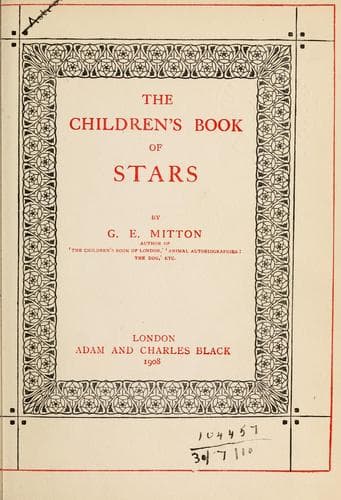
The Children's Book of StarsMitton, G. E. (Geraldine Edith)
Science
The Children's Book of Stars
Mitton, G. E. (Geraldine Edith)
Astronomy -- Juvenile literature
We know that the moon has no heat of her own--she parted with all that
long ago; she cannot give us glowing light from brilliant flames, as the
sun does; she shines only by the reflection of the sun on her surface,
and this is the reason why she appears to change her shape so
constantly. She does not really change; the whole round moon is always
there, only part of it is in shadow. Sometimes you can see the dark part
as well as the bright. When there is a crescent moon it looks as if it
were encircling the rest; some people call it, 'seeing the old moon in
the new moon's arms.' I don't know if you would guess why it is we can
see the dark part then, or how it is lighted up. It is by reason of our
own shining, for we give light to the moon, as she does to us. The sun's
rays strike on the earth, and are reflected on to the moon, so that the
moon is lighted by earthshine as we are lighted by moonshine, and it is
these reflected earth-rays that light up the dark part of the moon and
enable us to see it. What a journey these rays have had! They travel
from the sun to the earth, and the earth to the moon, and then back to
the earth again! From the moon the earth must appear a much bigger and
more glorious spectacle than she does to us--four times wider across and
probably brighter--for the sun's light strikes often on our clouds,
which shine more brilliantly than her surface.
Once again we must use an illustration to explain the subject. Set a
lamp in the middle of a dark room, and let that be the sun, then take a
small ball to represent the earth and a smaller one for the moon. Place
the moon-ball between the lamp and the earth-ball. You will see that the
side turned to the earth-ball is dark, but if you move the moon to one
side of the earth, then from the earth half of it appears light and half
dark; if you put it right away from the lamp, on the outer side of the
earth, it is all gloriously lit up, unless it happens to be exactly
behind the earth, when the earth's shadow will darken it. This is the
full explanation of all the changes of the moon.
[Illustration: AN ECLIPSE OF THE MOON.]
Public-domain text, read in full here on John Shaqi.
Reviews
Reviews
No reviews yet
Be the first to share your thoughts on this work.
Join the Discussion
Join the discussion
Sign in to leave a comment or review.
Sign InorCreate an account