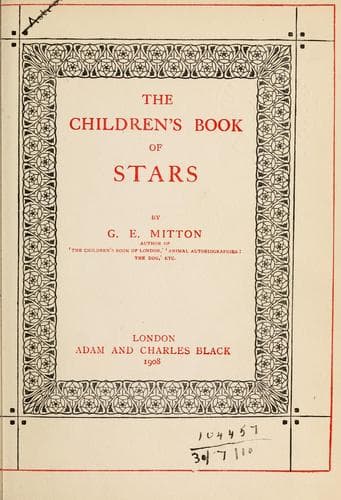
The Children's Book of StarsMitton, G. E. (Geraldine Edith)
Science
The Children's Book of Stars
Mitton, G. E. (Geraldine Edith)
Astronomy -- Juvenile literature
For a very long time astronomers could not discover what time Venus took
in rotating on her own axis--that is to say, what the length of her day
was. She is difficult to observe, and in order to find out the rotation
it is necessary to note some fixed object on the surface which turns
round with the planet and comes back to the same place again, so that
the time it takes in its journey can be measured. But the surface of
Venus is always changing, so that it is impossible to judge at all
certainly. Opinions differ greatly, some astronomers holding that
Venus's day is not much longer than an earthly day, while others believe
that the planet's day is equal to her year, just as in the case of
Mercury. Venus's year is 225 days, or about seven and a half of our
months, and if, indeed, her day and year are the same length, very
peculiar effects would follow. For instance, terrible heat would be
absorbed by the side of the planet facing the sun in the perpetual
summer; and the cold which would be felt in the dreary winter's night
would far exceed our bitterest Arctic climate. We cannot but fancy that
any beings who might live on a planet of this kind must be different
altogether from ourselves. Then, there is another point: even here on
earth very strong winds are caused by the heating of the tropics; the
hot air, being lighter than the cold air, rises, and the colder air from
the poles rushes in to supply its place. This causes wind, but the winds
which would be raised on Venus by the rush of air from the icy side of
the planet to the hot one would be tornadoes such as we could but
faintly dream of. It is, of course, useless to speculate when we know so
little, but in a subject so intensely interesting we cannot help
guessing a little.
Venus is only slightly smaller than the earth, and her density is not
very unlike ours; therefore the pull of gravity must be pretty much
there what it is here--that is to say, things will weigh at her surface
about the same as they do here. Her orbit is nearly a circle, so that
her distance from the sun does not vary much, and the heat will not be
much greater from this cause at one time of the year than another.
As her orbit is tilted up a little she does not pass between us and the
sun at each revolution, but occasionally she does so, and this passing
is called a transit. Many important facts have been learned by watching
these transits. Mercury also has transits across the sun, but as she is
so much smaller than Venus they are not of such great importance. It was
by the close observation of Venus during her transits that the distance
from the earth to the sun was first measured. Not until the year 2004
will another transit of Venus occur.
Public-domain text, read in full here on John Shaqi.
Reviews
Reviews
No reviews yet
Be the first to share your thoughts on this work.
Join the Discussion
Join the discussion
Sign in to leave a comment or review.
Sign InorCreate an account