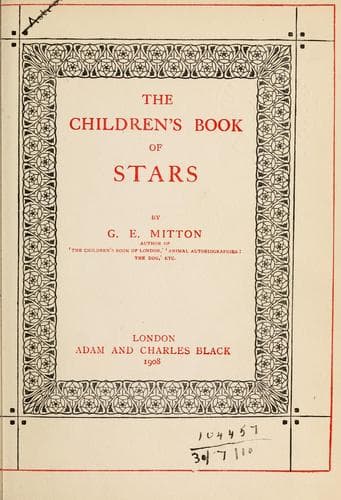
The Children's Book of StarsMitton, G. E. (Geraldine Edith)
Science
The Children's Book of Stars
Mitton, G. E. (Geraldine Edith)
Astronomy -- Juvenile literature
power--on one side than the other, and by distinguishing the sides
and watching carefully, astronomers have come to the conclusion that it
presents always the same face to Saturn in the same way as our own moon
does to us; in fact, there is reason to think that all the moons of
large planets do this.
[Illustration: THE PLANET SATURN WITH TWO OF HIS MOONS.]
All the moons lie outside the rings, and some at a very great distance
from Saturn, so that they can only appear small as seen from him. Yet at
the worst they must be brighter than ordinary stars, and add greatly to
the variations in the sky scenery of this beautiful planet. In
connection with Saturn's moons there is another of those astonishing
facts that are continually cropping up to remind us that, however much
we know, there is such a vast deal of which we are still ignorant. So
far in dealing with all the planets and moons in the solar system we
have made no remark on the way they rotate or revolve, because they all
go in the same direction, and that direction is called
counter-clockwise, which means that if you stand facing a clock and turn
your hand slowly round the opposite direction to that in which the hands
go, you will be turning it in the same way that the earth rotates on its
axis and revolves in its orbit. It is, perhaps, just as well to give
here a word of caution. Rotating of course means a planet's turning on
its own axis, revolving means its course in its orbit round the sun.
Mercury, Venus, Earth, Mars, Jupiter, and all their moons, as well as
Saturn himself, rotate on their axes in this one
direction--counter-clockwise--and revolve in the same direction as they
rotate. Even the queer little moon of Mars, which runs round him quicker
than he rotates, obeys this same rule. Nine of Saturn's moons follow
this example, but one independent little one, which has been named
Phoebe, and is far out from the planet, actually revolves in the
opposite way. We cannot see how it rotates, but if, as we said just now,
it turns the same face always to Saturn, then of course it rotates the
wrong way too. A theory has been suggested to account for this curious
fact, but it could not be made intelligible to anyone who has not
studied rather high mathematics, so there we must just leave it, and put
it in the cabinet of curiosities we have already collected on our way
out to Saturn.
Public-domain text, read in full here on John Shaqi.
Reviews
Reviews
No reviews yet
Be the first to share your thoughts on this work.
Join the Discussion
Join the discussion
Sign in to leave a comment or review.
Sign InorCreate an account