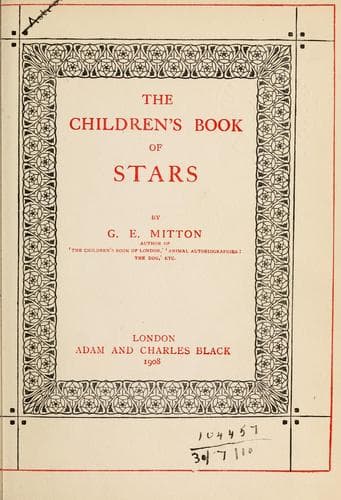
The Children's Book of StarsMitton, G. E. (Geraldine Edith)
Science
The Children's Book of Stars
Mitton, G. E. (Geraldine Edith)
Astronomy -- Juvenile literature
For ages past men have known and watched the planets lying within the
orbit of Saturn, and they had made up their minds that this was the
limit of our system. But in 1781 a great astronomer named Herschel was
watching the heavens through a telescope when he noticed one strange
object that he was certain was no star. The vast distance of the stars
prevents their having any definite outline, or what is called a disc.
The rays dart out from them in all directions and there is no 'edge' to
them, but in the case of the planets it is possible to see a disc with a
telescope, and this object which attracted Herschel's attention had
certainly a disc. He did not imagine he had discovered a new planet,
because at that time the asteroids had not been found, and no one
thought that there could be any more planets. Yet Herschel knew that
this was not a star, so he called it a comet! He was actually the first
who discovered it, for he knew it was not a fixed star, but it was after
his announcement of this fact that some one else, observing it
carefully, found it to be a real planet with an orbit lying outside that
of Saturn, then the furthest boundary of the solar system. Herschel
suggested calling it Georgius Sidus, in honour of George III., then
King; but luckily this ponderous name was not adopted, and as the other
planets had been called after the Olympian deities, and Uranus was the
father of Saturn, it was called Uranus. It was subsequently found that
this new planet had already been observed by other astronomers and
catalogued as a star no less than seventeen times, but until Herschel's
clear sight had detected the difference between it and the fixed stars
no one had paid any attention to it. Uranus is very far away from the
sun, and can only sometimes be seen as a small star by people who know
exactly where to look for him. In fact, his distance from the sun is
nineteen times that of the earth.
Yet to show at all he must be of great size, and that size has actually
been found out by the most delicate experiments. If we go back to our
former comparison, we shall remember that if the earth were like a
greengage plum, then Uranus would be in comparison about the size of one
of those coloured balloons children play with; therefore he is much
larger than the earth.
In this far distant orbit the huge planet takes eighty-four of our years
to complete one of his own. A man on the earth will have grown from
babyhood to boyhood, from boyhood to the prime of life, and lived longer
than most men, while Uranus has only once circled in his path.
Public-domain text, read in full here on John Shaqi.
Reviews
Reviews
No reviews yet
Be the first to share your thoughts on this work.
Join the Discussion
Join the discussion
Sign in to leave a comment or review.
Sign InorCreate an account