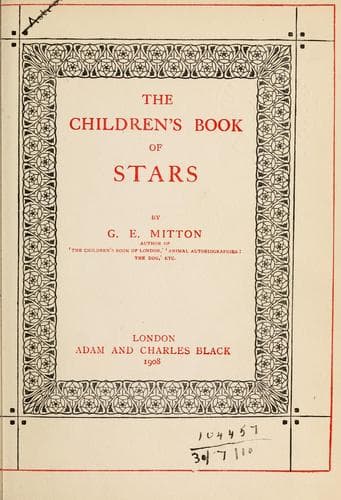
The Children's Book of StarsMitton, G. E. (Geraldine Edith)
Science
The Children's Book of Stars
Mitton, G. E. (Geraldine Edith)
Astronomy -- Juvenile literature
But in dealing with Uranus we come to another of those startling
problems of which astronomy is full. So far we have dealt with planets
which are more or less upright, which rotate with a rotation like that
of a top. Now take a top and lay it on one side on the table, with one
of its poles pointing toward the great lamp we used for the sun and the
other pointing away. That is the way Uranus gets round his path, on his
side! He rotates the wrong way round compared with the planets we have
already spoken of, but he revolves the same way round the sun that all
the others do. It seems wonderful that even so much can be found out
about a body so far from us, but we know more: we have discovered that
Uranus is made of lighter material than the earth; his density is less.
How can that be known? Well, you remember every body attracts every
other body in proportion to the atoms it contains. If, therefore, there
were any bodies near to Uranus, it could be calculated by his influence
on them what was his own mass, which, as you remember, is the word we
use to express what would be weight were it at the earth's surface; and
far away as Uranus is, the bodies from which such calculations may be
made have been discovered, for he has no less than four satellites, or
moons. Considering now the peculiar position of the planet, we might
expect to find these moons revolving in a very different way from
others, and this is indeed the case. They turn round the planet at
about its Equator--that is to say, if you hold the top representing
Uranus as was suggested just now, these moons would go above and below
the planet in passing round it. Only we must remember there is really no
such thing as above and below absolutely. We who are on one side of the
world point up to the sky and down to the earth, while the people on the
other side of the earth, say at New Zealand, also point up to the sky
and down to the earth, but their pointings are directly the opposite of
ours. So when we speak of moons going above and below that is only
because, for the moment, we are representing Uranus as a top we hold in
our hands, and so we speak of above and below as they are to us.
It was Herschel who discovered these satellites, as well as the planet,
and for these great achievements he occupies one of the grandest places
in the role of names of which England is proud. But he did much more
than this: his improvements in the construction of telescopes, and his
devotion to astronomy in many other ways, would have caused him to be
remembered without anything else.
Of Uranus's satellites one, the nearest, goes round in about two and a
half days, and the one that is furthest away takes about thirteen and a
half days, so both have a shorter period than our moon.
Public-domain text, read in full here on John Shaqi.
Reviews
Reviews
No reviews yet
Be the first to share your thoughts on this work.
Join the Discussion
Join the discussion
Sign in to leave a comment or review.
Sign InorCreate an account