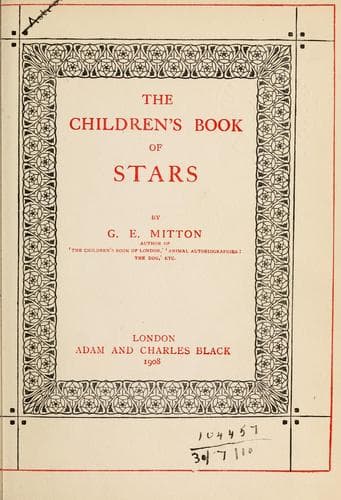
The Children's Book of StarsMitton, G. E. (Geraldine Edith)
Science
The Children's Book of Stars
Mitton, G. E. (Geraldine Edith)
Astronomy -- Juvenile literature
To begin at the beginning, we must go back to the time when the sun was
only a great gaseous nebula filling all the space included in the orbit
of Neptune. This nebula was not in itself hot, but as it rotated it
contracted. Now, heat is really only a form of energy, and energy and
heat can be interchanged easily. This is a very startling thing when
heard for the first time, but it is known as surely as we know anything
and has been proved again and again. When a savage wants to make a fire
he turns a piece of hard wood very very quickly between his
palms--twiddles it, we should say expressively--into a hole in another
piece of wood, until a spark bursts out. What is the spark? It is the
energy of the savage's work turned to heat. When a horse strikes his
iron-shod hoofs hard on the pavement you see sparks fly; that is caused
by the energy of the horse's leg. When you pump hard at your bicycle you
feel your pump getting quite hot, for part of the energy you are putting
into your work is transformed into heat; and so on in numberless
instances. No energetic action of any kind in this world takes place
without some of the energy being turned into heat, though in many
instances the amount is so small as to be unnoticeable. Nothing falls
to the ground without some heat being generated. Now, when this great
nebula first began its remarkable career, by the action of gravity all
the particles in it were drawn toward the centre; little by little they
fell in, and the nebula became smaller. We are not now concerned with
the origin of the planets--we leave that aside; we are only
contemplating the part of the nebula which remained to become the sun.
Now these particles being drawn inward each generated some heat, so as
the nebula contracted its temperature rose. Throughout the ages, over
the space of millions and millions of miles, it contracted and grew
hotter. It still remained gaseous, but at last it got to an immense
temperature, and is the sun as we know it. What then keeps it shining?
It is still contracting, but slowly, so slowly that it is quite
imperceptible to our finest instruments. It has been calculated that if
it contracts two hundred and fifty feet in diameter in a year, the
energy thus gained and turned into heat is quite sufficient to account
for its whole yearly output. This is indeed marvellous. In comparison
with the sun's size two hundred and fifty feet is nothing. It would take
nine thousand years at this rate before any diminution could be noticed
by our finest instruments! Here is a source of heat which can continue
for countless ages without exhaustion. Thus to all intents and purposes
we may say the sun's shining is inexhaustible. Yet we must follow out
the train of reasoning, and see what will happen in the end, in eras and
eras of time, if nothing intervenes. Well, some gaseous bodies are far
finer and more tenuous than others, and when a gaseous body contracts it
Public-domain text, read in full here on John Shaqi.
Reviews
Reviews
No reviews yet
Be the first to share your thoughts on this work.
Elsewhere in the archive
Join the Discussion
Join the discussion
Sign in to leave a comment or review.
Sign InorCreate an account