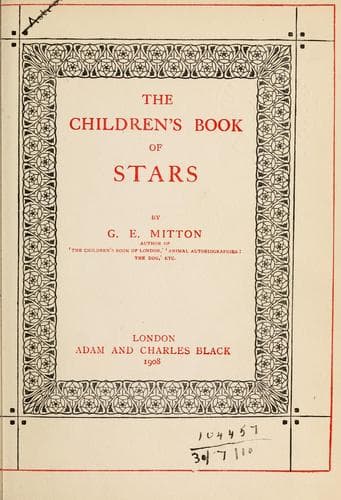
The Children's Book of StarsMitton, G. E. (Geraldine Edith)
Science
The Children's Book of Stars
Mitton, G. E. (Geraldine Edith)
Astronomy -- Juvenile literature
is all the time getting denser; as it grows denser and denser it at last
becomes liquid, and then solid, and then it ceases to contract, as of
course the particles of a solid body cannot fall freely toward the
centre, as those of a gaseous body can. Our earth has long ago reached
this stage. When solid the action ceases, and the heat is no more kept
up by this source of energy, therefore the body begins to cool--surface
first, and lastly the interior; it cools more quickly the smaller it is.
Our moon has parted with all her heat long ago, while the earth still
retains some internally. In the sun, therefore, we have an object-lesson
of the stages through which all the planets must have passed. They have
all once been glowing hot, and some may be still hot even on the
surface, as we have seen there is reason to believe is the case with
Jupiter.
By this marvellous arrangement for the continued heat of the sun we can
see that the warmth of our planets is assured for untold ages. There is
no need to fear that the sun will wear out by burning. His brightness
will continue for ages beyond the thoughts of man.
Besides this, a few other things have been discovered about him. He is,
of course, exceptionally difficult to observe; for though he is so
large, which should make it easy, he is so brilliant that anyone
regarding him through a telescope without the precaution of prepared
glasses to keep off a great part of the light would be blinded at once.
One most remarkable fact about the sun is that his surface is flecked
with spots, which appear sometimes in greater numbers and sometimes in
less, and the reason and shape of these spots have greatly exercised
men's minds. Sometimes they are large enough to be seen without a
telescope at all, merely by looking through a piece of smoked or
coloured glass, which cuts off the most overpowering rays. When they are
visible like this they are enormous, large enough to swallow many earths
in their depths. At other times they may be observed by the telescope,
then they may be about five thousand miles across. Sometimes one spot
can be followed by an astronomer as it passes all across the sun,
disappears at the edge, and after a lapse of time comes back again round
the other edge. This first showed men that the sun, like all the
planets, rotated on his axis, and gave them the means of finding out how
long he took in doing so. But the spots showed a most surprising result,
for they took slightly different times in making their journey round the
sun, times which differed according to their position. For instance, a
spot near the equator of the sun took twenty-five days to make the
circuit, while one higher up or lower down took twenty-six days, and one
further out twenty-seven; so that if these spots are, as certainly
believed, actually on the surface, the conclusion is that the sun does
not rotate all in one piece, but that some parts go faster than others.
Public-domain text, read in full here on John Shaqi.
Reviews
Reviews
No reviews yet
Be the first to share your thoughts on this work.
Elsewhere in the archive
Join the Discussion
Join the discussion
Sign in to leave a comment or review.
Sign InorCreate an account