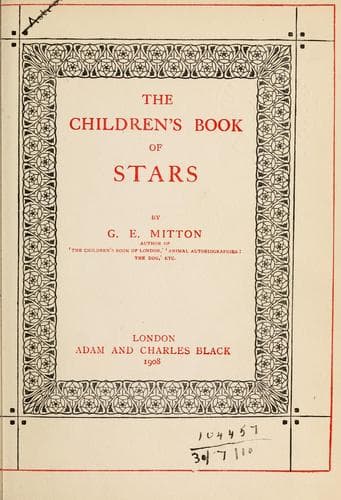
The Children's Book of StarsMitton, G. E. (Geraldine Edith)
Science
The Children's Book of Stars
Mitton, G. E. (Geraldine Edith)
Astronomy -- Juvenile literature
After this we might jump to the conclusion that all the bright large
stars are really small and near to us, and all the faintly shining ones
large and far away. But that would not be true at all, for some bright
ones are very far away and some faint ones comparatively near, so that
all we can do is to learn about them from the people who have studied
them and found out about them, and then we shall know of our own
knowledge which of them seem bright only because they are nearer than
the others, and which are really very, very brilliant, and so still
shine brightly, though set in space at an almost infinite distance from
us.
The sun, as we all know, appears to cross the sky every day; he gets up
in the east and drops down in the west, and the moon does the same,
only the moon is unlike the sun in this, that it changes its shape
continually. We see a crescent moon growing every night larger and
larger, until it becomes full and fat and round, and then it grows
thinner and thinner, until it dies away; and after a little while it
begins again, and goes through all the same changes once more. I will
tell you why this is so further on, when we have a chapter all about the
moon.
If you watch the stars quietly for at least five minutes, you will see
that they too are moving steadily on in the same way as the sun and
moon. Watch one bright star coming out from behind a chimney-pot, and
after about five minutes you will see that it has changed its place. Yet
this is not true of all, for if we watch carefully we shall find that
some, fairly high up in the sky, do not appear to move at all. The few
which are moving so slowly that they seem to us to stand still are at a
part of the sky close to the Pole Star, so called because it is always
above the North Pole of the earth. I will explain to you how to find it
in the sky for yourselves later on, but now you can ask anyone to point
it out. Watch it. It appears to be fixed in one place, while the other
stars are swinging round it in circles. In fact, it is as if we on the
earth were inside a great hollow globe or ball, which continually turned
round, with the Pole Star near the top of the globe; and you know that
if you put your finger on the spot at the top of a spinning globe or
ball, you can hold it there while all the rest of the ball runs round.
Now, if you had to explain things to yourself, you would naturally
think: 'Here is the great solid earth standing still, and the sun and
moon go round it; the stars are all turning round it too, just as if
they were fixed on to the inside of a hollow globe; we on the earth are
in the middle looking up at them; and this great globe is slowly
wheeling round us night by night.'
Public-domain text, read in full here on John Shaqi.
Reviews
Reviews
No reviews yet
Be the first to share your thoughts on this work.
Join the Discussion
Join the discussion
Sign in to leave a comment or review.
Sign InorCreate an account