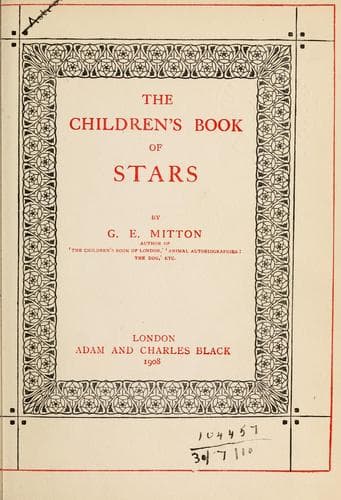
The Children's Book of StarsMitton, G. E. (Geraldine Edith)
Science
The Children's Book of Stars
Mitton, G. E. (Geraldine Edith)
Astronomy -- Juvenile literature
No one can really explain how this could be, but it is certainly more
easily understood in the case of a body of gas than of a solid body,
when it would be simply impossible to conceive. The spots seem to keep
principally a little north and a little south of the equator; there are
very few actually at it, and none found near the poles, but no reason
for this distribution has been discovered. It has been noted that about
every eleven years the greatest number of spots appears, and that
they become fewer again, mounting up in number to the next eleven years,
and so on. All these curious facts show there is much yet to be solved
about the sun. The spots were supposed for long to be eruptions bursting
up above the surface, but now they are generally held to be deep
depressions like saucers, probably caused by violent tempests, and it is
thought that the inrush of cooler matter from above makes them look
darker than the other parts of the sun's surface. But when we use the
words 'cooler' and 'darker,' we mean only by comparison, for in reality
the dark parts of the spots are brighter than electric light.
[Illustration: _Royal Observatory, Greenwich._
SUN-SPOTS.]
The fact that the spots are in reality depressions or holes is shown by
their change of appearance as they pass over the face of the sun toward
the edge; for the change of shape is exactly that which would be caused
by foreshortening.
It sounds odd to say that the best time for observing the sun is during
a total eclipse, for then the sun's body is hidden by the moon. But yet
to a certain extent this is true, and the reason is that the sun's own
brilliance is our greatest hindrance in observing him, his rays are so
dazzling that they light up our own atmosphere, which prevents us seeing
the edges. Now, during a total eclipse, when nearly all the rays are
cut off, we can see marvellous things, which are invisible at other
times. But total eclipses are few and far between, and so when one is
approaching astronomers make great preparations beforehand.
Public-domain text, read in full here on John Shaqi.
Reviews
Reviews
No reviews yet
Be the first to share your thoughts on this work.
Elsewhere in the archive
Join the Discussion
Join the discussion
Sign in to leave a comment or review.
Sign InorCreate an account