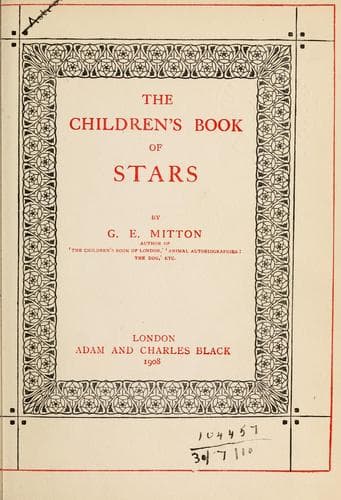
The Children's Book of StarsMitton, G. E. (Geraldine Edith)
Science
The Children's Book of Stars
Mitton, G. E. (Geraldine Edith)
Astronomy -- Juvenile literature
I said just now a pale green halo surrounded the sun, extending far
beyond the prominences; this is called the corona and can only be seen
during an eclipse. It surrounds the sun in a kind of shell, and there is
reason to believe that it too is made of luminous stuff ejected by the
sun in its burning fury. It is composed of large streamers or filaments,
which seem to shoot out in all directions; generally these are not much
larger than the apparent width of the sun, but sometimes they extend
much further. The puzzle is, this corona cannot be an atmosphere in any
way resembling that of our earth; for the gravitational force of the
sun, owing to its enormous size, is so great that it would make any such
atmosphere cling to it much more densely near to the surface, while it
would be thinner higher up, and the corona is not dense in any way, but
thin and tenuous throughout. This makes it very difficult to explain; it
is supposed that some kind of electrical force enters into the problem,
but what it is exactly we are far from knowing yet.
CHAPTER VIII
SHINING VISITORS
Our solar system is set by itself in the midst of a great space, and so
far as we have learnt about it in this book everything in it seems
orderly: the planets go round the sun and the satellites go round the
planets, in orbits more or less regular; there seems no place for
anything else. But when we have considered the planets and the
satellites, we have not exhausted all the bodies which own allegiance to
the sun. There is another class, made up of strange and weird members,
which flash in and out of the system, coming and going in all directions
and at all times--sometimes appearing without warning, sometimes
returning with a certain regularity, sometimes retiring to infinite
depths of space, where no human eye will ever see them more. These
strange visitors are called comets, and are of all shapes and sizes and
never twice alike. Even as we watch them they grow and change, and then
diminish in splendour. Some are so vast that men see them as flaming
signs in the sky, and regard them with awe and wonder; some cannot be
seen at all without the help of the telescope. From the very earliest
ages those that were large enough to be seen without glasses have been
regarded with astonishment. Men used to think that they were signs from
heaven foretelling great events in the world. Timid people predicted
that the end of the world would come by collision with one of them.
Others, again, fancifully likened them to fishes in that sea of space in
which we swim--fishes gigantic and terrifying, endowed with sense and
will.
Public-domain text, read in full here on John Shaqi.
Reviews
Reviews
No reviews yet
Be the first to share your thoughts on this work.
Elsewhere in the archive
Join the Discussion
Join the discussion
Sign in to leave a comment or review.
Sign InorCreate an account