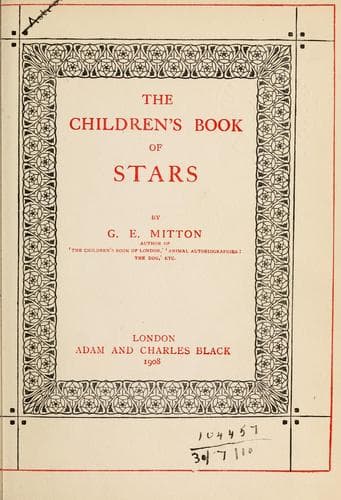
The Children's Book of StarsMitton, G. E. (Geraldine Edith)
Science
The Children's Book of Stars
Mitton, G. E. (Geraldine Edith)
Astronomy -- Juvenile literature
A total eclipse is not visible from all parts of the world, but only
from that small part on which the shadow of the moon falls, and as the
earth travels, this shadow, which is really a round spot, passes along,
making a dark band. In this band astronomers choose the best
observatories, and there they take up their stations. The dark body of
the moon first appears to cut a little piece out of the side of the sun,
and as it sails on, gradually blotting out more and more, eager
telescopes follow it; at last it covers up the whole sun, and then a
marvellous spectacle appears, for all round the edges of the black moon
are seen glorious red streamers and arches and filaments of marvellous
shapes, continually changing. These are thrown against a background of
pale green light that surrounds the black moon and the hidden sun. In
early days astronomers thought these wonderful coloured streamers
belonged to the moon; but it was soon proved that they really are part
of the sun, and are only invisible at ordinary times, because our
atmosphere is too bright to allow them to be seen. An instrument has
now been invented to cut off most of the light of the sun, and when this
is attached to a telescope these prominences, as they are called, can be
seen at any time, so that there is no need to wait for an eclipse.
[Illustration: THE EARTH AS IT WOULD APPEAR IN COMPARISON WITH THE
FLAMES SHOOTING OUT FROM THE SUN.]
What are these marvellous streamers and filaments? They are what they
seem, eruptions of fiery matter discharged from the ever-palpitating sun
thousands of miles into surrounding space. They are for ever shooting
out and bursting and falling back, fireworks on a scale too enormous for
us to conceive. Some of these brilliant flames extend for three hundred
thousand miles, so that in comparison with one of them the whole world
would be but a tiny ball, and this is going on day and night without
cessation. Look at the picture where the artist has made a little black
ball to represent the earth as she would appear if she could be seen in
the midst of the flames shooting out from the sun. Do not make a mistake
and think the earth really could be in this position; she is only shown
there so that you may see how tiny she is in comparison with the sun.
All the time you have lived and your father, and grandfather, and right
back to the beginnings of English history, and far, far further into the
dim ages, this stupendous exhibition of energy and power has continued,
and only of late years has anyone known anything about it; even now a
mere handful of people do know, and the rest, who are warmed and fed and
kept alive by the gracious beams of this great revolving glowing
fireball, never give it a thought.
Public-domain text, read in full here on John Shaqi.
Reviews
Reviews
No reviews yet
Be the first to share your thoughts on this work.
Elsewhere in the archive
Join the Discussion
Join the discussion
Sign in to leave a comment or review.
Sign InorCreate an account