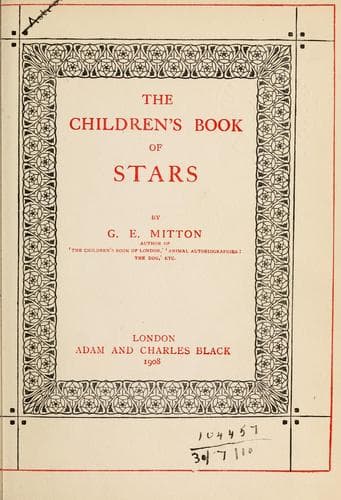
The Children's Book of StarsMitton, G. E. (Geraldine Edith)
Science
The Children's Book of Stars
Mitton, G. E. (Geraldine Edith)
Astronomy -- Juvenile literature
All the substances which we are accustomed to see and handle in our
daily lives belong to our world. There are vegetables which grow in the
earth, minerals which are dug out of it, and elementary things, such as
air and water, which have always made up a part of this planet since man
knew it. These are obvious, but there are other things not quite so
obvious which also help to form our world. Among these we may class all
the elements known to chemists, many of which have difficult names, such
as oxygen and hydrogen. These two are the elements which make up water,
and oxygen is an important element in air, which has nitrogen in it too.
There are numbers and numbers of other elements perfectly familiar to
chemists, of which many people never even hear the names. We live in the
midst of these things, and we take them for granted and pay little
attention to them; but when we begin to learn about other worlds we at
once want to know if these substances and elements which enter so
largely into our daily lives are to be found elsewhere in the universe
or are quite peculiar to our own world. This question might be answered
in several ways, but one of the most practical tests would be if we
could get hold of something which had not been always on the earth, but
had fallen upon it from space. Then, if this body were made up of
elements corresponding with those we find here, we might judge that
these elements are very generally diffused throughout the bodies in the
solar system.
It sounds in the highest degree improbable that anything should come
hurling through the air and alight on our little planet, which we know
is a mere speck in a great ocean of space; but we must not forget that
the power of gravity increases the chances greatly, for anything coming
within a certain range of the earth, anything small enough, that is, and
not travelling at too great a pace, is bound to fall on to it. And,
however improbable it seems, it is undoubtedly true that masses of
matter do crash down upon the earth from time to time, and these are
called meteorites. When we think of the great expanse of the oceans, of
the ice round the poles, and of the desert wastes, we know that for
every one of such bodies seen to fall many more must have fallen unseen
by any human being. Meteors large enough to reach the earth are not very
frequent, which is perhaps as well, and as yet there is no record of
anyone's having been killed by them. Most of them consist of masses of
stone, and a few are of iron, while various substances resembling those
that we know here have been found in them. Chemists in analyzing them
have also come across certain elements so far unknown upon earth, though
of course there is no saying that these may not exist at depths to which
man has not penetrated.
Public-domain text, read in full here on John Shaqi.
Reviews
Reviews
No reviews yet
Be the first to share your thoughts on this work.
Elsewhere in the archive
Join the Discussion
Join the discussion
Sign in to leave a comment or review.
Sign InorCreate an account