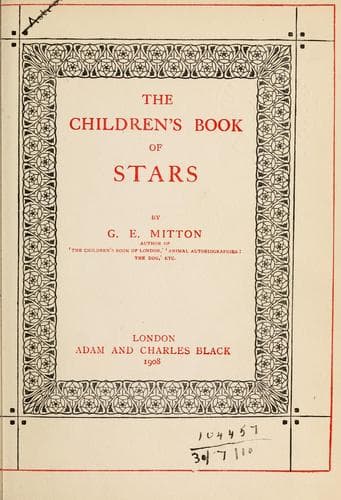
The Children's Book of StarsMitton, G. E. (Geraldine Edith)
Science
The Children's Book of Stars
Mitton, G. E. (Geraldine Edith)
Astronomy -- Juvenile literature
A really large meteor is a grand sight. If it is seen at night it
appears as a red star, growing rapidly bigger and leaving a trail of
luminous vapour behind as it passes across the sky. In the daytime this
vapour looks like a cloud. As the meteor hurls itself along there may be
a deep continuous roar, ending in one supreme explosion, or perhaps in
several explosions, and finally the meteor may come to the earth in one
mass, with a force so great that it buries itself some feet deep in the
soil, or it may burst into numbers of tiny fragments, which are
scattered over a large area. When a meteor is found soon after its fall
it is very hot, and all its surface has 'run,' having been fused by
heat. The heat is caused by the friction of our atmosphere. The meteor
gets entangled in the atmosphere, and, being drawn by the attraction of
the earth, dashes through it. Part of the energy of its motion is turned
to heat, which grows greater and greater as the denser air nearer to the
earth is encountered; so that in time all the surface of the meteor runs
like liquid, and this liquid, rising to a still higher temperature, is
blown off in vapour, leaving a new surface exposed. The vapour makes the
trail of fire or cloud seen to follow the meteor. If the process went on
for long the meteor would be all dissipated in vapour, and in any case
it must reach the earth considerably reduced in size.
Numbers and numbers of comparatively small ones disappear, and for every
one that manages to come to earth there must be hundreds seen only as
shooting stars, which vanish and 'leave not a wrack behind.' When a
meteor is seen to fall it is traced, and, whenever possible, it is found
and placed in a museum. Men have sometimes come across large masses of
stone and iron with their surfaces fused with heat. These are in every
way like the recognized meteorites, except that no eye has noted their
advent. As there can be no reasonable doubt that they are of the same
origin as the others, they too are collected and placed in museums, and
in any large museum you would be able to see both kinds--those which
have been seen to come to earth and those which have been found
accidentally.
Public-domain text, read in full here on John Shaqi.
Reviews
Reviews
No reviews yet
Be the first to share your thoughts on this work.
Elsewhere in the archive
Join the Discussion
Join the discussion
Sign in to leave a comment or review.
Sign InorCreate an account