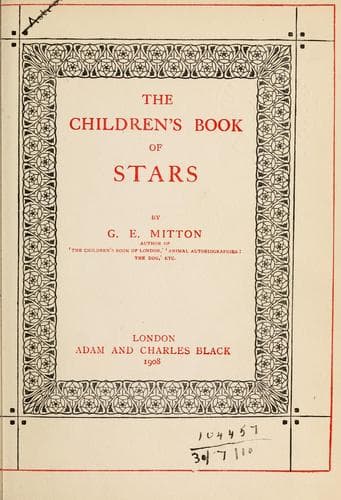
The Children's Book of StarsMitton, G. E. (Geraldine Edith)
Science
The Children's Book of Stars
Mitton, G. E. (Geraldine Edith)
Astronomy -- Juvenile literature
chances of their encountering the earth would be small. Both these
theories are now discarded. It is believed that the meteors are merely
lesser fragments of the same kind of materials as the planets, circling
independently round the sun; and a proof of this is that far more
meteorites fall on that part of the earth which is facing forward in its
journey than on that behind, and this is what we should expect if the
meteors were scattered independently through space and it was by reason
of our movements that we came in contact with them. There is no need to
explain this further. Everyone knows that in cycling or driving along a
road where there is a good deal of traffic both ways the people we meet
are more in number than those who overtake us, and the same result would
follow with the meteors; that is to say, in travelling through space
where they were fairly evenly distributed we should meet more than we
should be overtaken by.
You remember that it was suggested the sun's fuel might be obtained from
meteors, and this was proved to be not possible, even though there are
no doubt unknown millions of these strange bodies circling throughout
the solar system.
There are so many names for these flashing bodies that we may get a
little confused: when they are seen in the sky they are meteors, or
fire-balls; when they reach the earth they are called meteorites, and
also aerolites. Then there is another class of the same bodies called
shooting stars, and these are in reality only meteors on a smaller
scale; but there ought to be no confusion in our thoughts, for all these
objects are small bodies travelling round the sun, and caught by the
earth's influence.
When you watch the sky for some time on a clear night, you will seldom
fail to see at least one star flash out suddenly in a path of thrilling
light and disappear, and you cannot be certain whether that star had
been shining in the sky a minute before, or if it had appeared suddenly
only in order to go out. The last idea is right. We must get rid at once
of the notion that it would be possible for any fixed star to behave in
this manner. To begin with, the fixed stars are many of them actually
travelling at a great velocity at present, yet so immeasurably distant
are they that their movement makes no perceptible difference to us. For
one of them to appear to dash across the heavens as a meteor does would
mean a velocity entirely unknown to us, even comparing it with the speed
of light. No, these shooting stars are not stars at all, though they
were so named, long before the real motions of the fixed stars were even
dimly guessed at. As we have seen, they belong to the same class as
meteors.
Public-domain text, read in full here on John Shaqi.
Reviews
Reviews
No reviews yet
Be the first to share your thoughts on this work.
Elsewhere in the archive
Join the Discussion
Join the discussion
Sign in to leave a comment or review.
Sign InorCreate an account