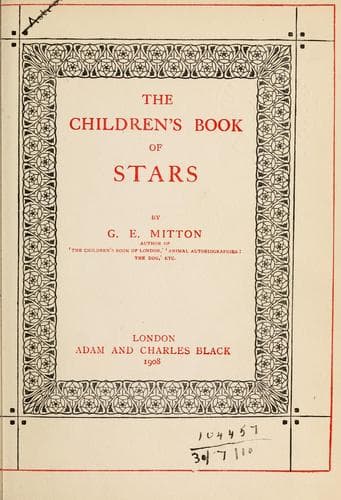
The Children's Book of StarsMitton, G. E. (Geraldine Edith)
Science
The Children's Book of Stars
Mitton, G. E. (Geraldine Edith)
Astronomy -- Juvenile literature
The meteors which appear very brilliant in their course across the sky
are sometimes called fire-balls, which is only another name for the same
thing. Some of these are brighter than the full moon, so bright that
they cause objects on earth to cast a shadow. In 1803 a fiery ball was
noticed above a small town in Normandy; it burst and scattered stones
far and wide, but luckily no one was hurt. The largest meteorites that
have been found on the earth are a ton or more in weight; others are
mere stones; and others again just dust that floats about in the
atmosphere before gently settling. Of course, meteors of this last kind
could not be seen to fall like the larger ones, yet they do fall in such
numbers that calculations have been made showing that the earth must
catch about a hundred millions of meteors daily, having altogether a
total weight of about a hundred tons. This sounds enormous, but
compared with the weight of the earth it is very small indeed.
Now that we have arrived at the fact that strange bodies do come
hurtling down upon us out of space, and that we can actually handle and
examine them, the next question is, Where do they come from? At one time
it was thought that they were fragments which had been flung off by the
earth herself when she was subject to violent explosions, and that they
had been thrown far enough to resist the impulse to drop down upon her
again, and had been circling round the sun ever since, until the earth
came in contact with them again and they had fallen back upon her. It is
not difficult to imagine a force which would be powerful enough to
achieve the feat of speeding something off at such a velocity that it
passed beyond the earth's power to pull it back, but nothing that we
have on earth would be nearly strong enough to achieve such a feat.
Imaginative writers have pictured a projectile hurled from a cannon's
mouth with such tremendous force that it not only passed beyond the
range of the earth's power to pull it back, but so that it fell within
the influence of the moon and was precipitated on to her surface! Such
things must remain achievements in imagination only; it is not possible
for them to be carried out. Other ideas as to the origin of meteors
were that they had been expelled from the moon or from the sun. It would
need a much less force to send a projectile away from the moon than from
the earth on account of its smaller size and less density, but the
distance from the earth to the moon is not very great, and any
projectile hurled forth from the moon would cross it in a comparatively
short time. Therefore if the meteorites come from the moon, the moon
must be expelling them still, and we might expect to see some evidence
of it; but we know that the moon is a dead world, so this explanation is
not possible. The sun, for its part, is torn by such gigantic
disturbances that, notwithstanding its vast size, there is no doubt
sufficient force there to send meteors even so far as the earth, but the
Public-domain text, read in full here on John Shaqi.
Reviews
Reviews
No reviews yet
Be the first to share your thoughts on this work.
Elsewhere in the archive
Join the Discussion
Join the discussion
Sign in to leave a comment or review.
Sign InorCreate an account