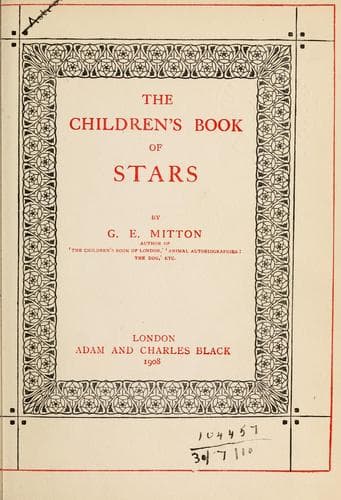
The Children's Book of StarsMitton, G. E. (Geraldine Edith)
Science
The Children's Book of Stars
Mitton, G. E. (Geraldine Edith)
Astronomy -- Juvenile literature
Not all at once, but gradually, the mystery of these shower displays was
solved. It was realized that the meteors need not necessarily come from
one fixed place in the sky because they seemed to us to do so, for that
was only an effect of perspective. If you were looking down a long,
perfectly straight avenue of tree-trunks, the avenue would seem to close
in, to get narrower and narrower at the far end until it became a point;
but it would not really do so, for you would know that the trees at the
far end were just the same distance from each other as those between
which you were standing. Now, two meteors starting from the same
direction at a distance from each other, and keeping parallel, would
seem to us to start from a point and to open out wider and wider as they
approached, but they would not really do so; it would only be, as in the
case of the avenue, an effect of perspective. If a great many meteors
did the same thing, they would appear to us all to start from one point,
whereas really they would be on parallel lines, only as they rushed to
meet us or we rushed to meet them this effect would be produced.
Therefore the first discovery was that these meteors were thousands and
thousands of little bodies travelling in lines parallel to each other,
like a swarm of little planets. To judge that their path was not a
straight line but a circle or ellipse was the next step, and this was
found to be the case. From taking exact measurements of their paths in
the sky an astronomer computed they were really travelling round the sun
in a lengthened orbit, an ellipse more like a comet's orbit than that of
a planet. But next came the puzzling question, Why did the earth
apparently hit them every year to some extent, and once in thirty-three
years seem to run right into the middle of them? This also was answered.
One has only to imagine a swarm of such meteors at first hastening
busily along their orbit, a great cluster all together, then, by the
near neighbourhood of some planet, or by some other disturbing causes,
being drawn out, leaving stragglers lagging behind, until at last there
might be some all round the path, but only thinly scattered, while the
busy, important cluster that formed the nucleus was still much thicker
than any other part. Now, if the orbit that the meteors followed cut the
orbit or path of the earth at one point, then every time the earth came
to what we may call the level crossing she must run into some of the
stragglers, and if the chief part of the swarm took thirty-three years
to get round, then once in about thirty-three years the earth must
strike right into it. This would account for the wonderful display. So
long drawn-out is the thickest part of the swarm that it takes a year to
pass the points at the level crossing. If the earth strikes it near the
front one year, she may come right round in time to strike into the rear
part of the swarm next year, so that we may get fine displays two years
Public-domain text, read in full here on John Shaqi.
Reviews
Reviews
No reviews yet
Be the first to share your thoughts on this work.
Elsewhere in the archive
Join the Discussion
Join the discussion
Sign in to leave a comment or review.
Sign InorCreate an account