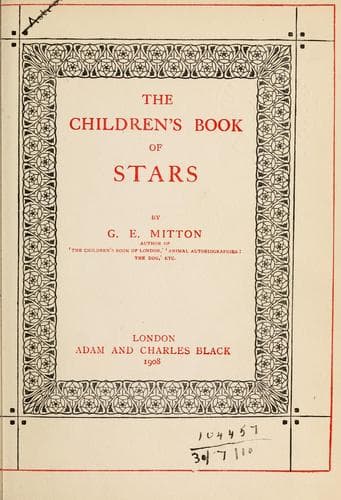
The Children's Book of StarsMitton, G. E. (Geraldine Edith)
Science
The Children's Book of Stars
Mitton, G. E. (Geraldine Edith)
Astronomy -- Juvenile literature
running about every thirty-three years. The last time we passed through
the swarm was in 1899, and then the show was very disappointing. Here in
England thick clouds prevented our seeing much, and there will not be
another chance for us to see it at its best until 1932.
These November meteors are called Leonids, because they _seem_ to come
from a group of stars named Leo, and though the most noticeable they are
not the only ones. A shower of the same kind occurs in August too, but
the August meteors, called Perseids, because they seem to come from
Perseus, revolve in an orbit which takes a hundred and forty-two years
to traverse! So that only every one hundred and forty-second year could
we hope to see a good display. When all these facts had been gathered
up, it seemed without doubt that certain groups of meteors travelled in
company along an elliptical orbit. But there remained still something
more--a bold and ingenious theory to be advanced. It was found that a
comet, a small one, only to be seen with the telescope, revolved in
exactly the same orbit as the November meteors, and another one, larger,
in exactly the same orbit as the August ones; hence it could hardly be
doubted that comets and meteors had some connection with each other,
though what that connection is exactly no one knows. Anyway, we can have
no shadow of doubt when we find the comet following a marked path, and
the meteors pursuing the same path in his wake, that the two have some
mysterious affinity. There are other smaller showers besides these of
November and August, and a remarkable fact is known about one of them.
This particular stream was found to be connected with a comet named
Biela's Comet, that had been many times observed, and which returned
about every seven years to the sun. After it had been seen several
times, this astonishing comet split in two and appeared as two comets,
both of which returned at the end of the next seven years. But on the
next two occasions when they were expected they never came at all, and
the third time there came instead a fine display of shooting stars, so
it really seemed as if these meteors must be the fragments of the lost
comet.
It is very curious and interesting to notice that in these star showers
there is no certain record of any large meteorite reaching the earth;
they seem to be made up of such small bodies that they are all
dissipated in vapour as they traverse our air.
CHAPTER X
THE GLITTERING HEAVENS
Public-domain text, read in full here on John Shaqi.
Reviews
Reviews
No reviews yet
Be the first to share your thoughts on this work.
Elsewhere in the archive
Join the Discussion
Join the discussion
Sign in to leave a comment or review.
Sign InorCreate an account