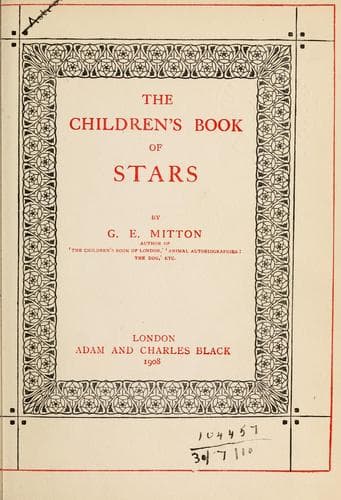
The Children's Book of StarsMitton, G. E. (Geraldine Edith)
Science
The Children's Book of Stars
Mitton, G. E. (Geraldine Edith)
Astronomy -- Juvenile literature
I say 'lie,' but that is really not the correct word. So far as we have
been able to find out, there is no such thing as absolute rest in the
universe--in fact, it is impossible; for even supposing any body could
be motionless at first, it would be drawn by the attraction of its
nearest neighbours in space, and gradually gain a greater and greater
velocity as it fell toward them. Even the stars we call 'fixed' are all
hurrying along at a great pace, and though their distance prevents us
from seeing any change in their positions, it can be measured by
suitable instruments. Our sun is no exception to this universal rule.
Like all his compeers, he is hurrying busily along somewhere in
obedience to some impulse of which we do not know the nature; and as he
goes he carries with him his whole cortege of planets and their
satellites, and even the comets. Yes, we are racing through space with
another motion, too, besides those of rotation and revolution, for our
earth keeps up with its master attractor, the sun. It is difficult, no
doubt, to follow this, but if you think for a moment you will remember
that when you are in a railway-carriage everything in that carriage is
really travelling along with it, though it does not appear to move. And
the whole solar system may be looked at as if it were one block in
movement. As in a carriage, the different bodies in it continue their
own movements all the time, while sharing in the common movement. You
can get up and change your seat in the train, and when you sit down
again you have not only moved that little way of which you are
conscious, but a great way of which you are not conscious unless you
look out of the window. Now in the case of the earth's own motion we
found it necessary to look for something which does not share in that
motion for purposes of comparison, and we found that something in the
sun, who shows us very clearly we are turning on our axis. But in the
case of the motion of the solar system the sun is moving himself, so we
have to look beyond him again and turn to the stars for confirmation.
Then we find that the stars have motions of their own, so that it is
very difficult to judge by them at all. It is as if you were bicycling
swiftly towards a number of people all walking about in different
directions on a wide lawn. They have their movements, but they all also
have an apparent movement, really caused by you as you advance toward
them; and what astronomers had to do was to separate the true movements
of the stars from the false apparent movement made by the advance of the
sun. This great problem was attacked and overcome, and it is now known
with tolerable certainty that the sun is sweeping onward at a pace of
about twelve miles a second toward a fixed point. It really matters very
little to us where he is going, for the distances are so vast that
hundreds of years must elapse before his movement makes the slightest
difference in regard to the stars. But there is one thing which we can
Public-domain text, read in full here on John Shaqi.
Reviews
Reviews
No reviews yet
Be the first to share your thoughts on this work.
Elsewhere in the archive
Join the Discussion
Join the discussion
Sign in to leave a comment or review.
Sign InorCreate an account