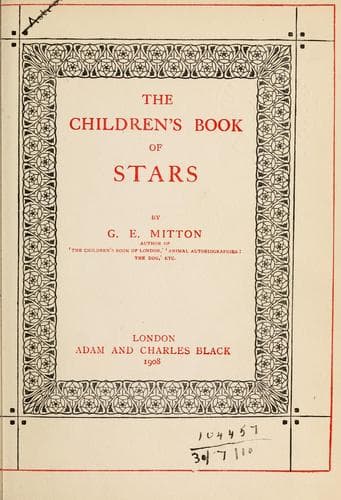
The Children's Book of StarsMitton, G. E. (Geraldine Edith)
Science
The Children's Book of Stars
Mitton, G. E. (Geraldine Edith)
Astronomy -- Juvenile literature
As science has advanced, the idea that these faraway suns must have
planetary attendants as our sun has been discarded. The more we know the
more is disclosed to us the infinite variety of the universe. For
instance, so much accustomed are we to a yellow sun that we never think
of the possibility of there being one of another colour. What would you
say then to a ruby sun, or a blue one; or to two suns of different
colours, perhaps red and green, circling round each other; or to two
such suns each going round a dark companion? For there are dark bodies
as well as shining bodies in the sky. These are some of the marvels of
the starry sky, marvels quite as absorbing as anything we have found in
the solar system.
It requires great care and patience and infinite labour before the very
delicate observations which alone can reveal to us anything of the
nature of the fixed stars can be accomplished. It is only since the
improvement in large telescopes that this kind of work has become
possible, and so it is but recently men have begun to study the stars
intimately, and even now they are baffled by indescribable difficulties.
One of these is our inability to tell the distance of a thing by merely
looking at it unless we also know its size. On earth we are used to
seeing things appear smaller the further they are from us, and by long
habit can generally tell the real size; but when we turn to the stars,
which appear so much alike, how are we to judge how far off they are?
Two stars apparently the same size and close together in the sky may
really be as far one from another as the earth is from the nearest; for
if the further one were very much larger than the nearer, they would
then appear the same size.
At first it was natural enough to suppose that the big bright stars of
what we call the first magnitude were the nearest to us, and the less
bright the next nearest, and so on down to the tiny ones, only revealed
by the telescope, which would be the furthest away of all; but research
has shown that this is not correct. Some of the brightest stars may be
comparatively near, and some of the smallest may be near also. The size
is no test of distance. So far as we have been able to discover, the
star which seems nearest _is_ a first magnitude one, but some of the
others which outshine it must be among the infinitely distant ones. Thus
we lie in the centre of a jewelled universe, and cannot tell even the
size of the jewels which cover its radiant robe.
Public-domain text, read in full here on John Shaqi.
Reviews
Reviews
No reviews yet
Be the first to share your thoughts on this work.
Elsewhere in the archive
Join the Discussion
Join the discussion
Sign in to leave a comment or review.
Sign InorCreate an account