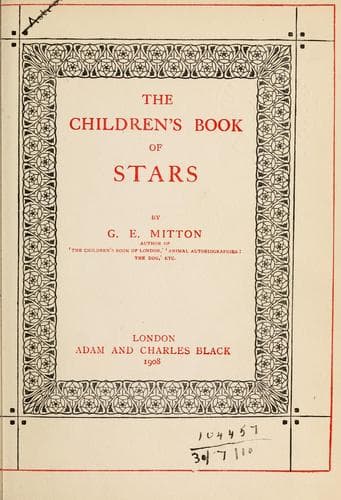
The Children's Book of StarsMitton, G. E. (Geraldine Edith)
Science
The Children's Book of Stars
Mitton, G. E. (Geraldine Edith)
Astronomy -- Juvenile literature
Supposing the axis of the earth were quite upright, straight up and down
in regard to the plane at which the earth goes round the sun, then we
should always see the same set of stars from the Northern and the same
set of stars from the Southern Hemispheres all the year round. But as
the axis is tilted slightly, we can, during our nights in the winter in
the Northern Hemisphere, see more of the sky to the south than we can in
the summer; and in the Southern Hemisphere just the reverse is the case,
far more stars to the north can be seen in the winter than in the
summer. But always, whether it is winter or summer, there is one fixed
point in each hemisphere round which all the other stars seem to swing,
and this is the point immediately over the North or the South Poles.
There is, luckily, a bright star almost at the point at which the North
Pole would seem to strike the sky were it infinitely lengthened. This is
not one of the brightest stars in the sky, but quite bright enough to
serve the purpose, and if we stand with our faces towards it, we can be
sure we are looking due north. How can we discover this star for
ourselves in the sky? Go out on any starlight night when the sky is
clear, and see if you can find a very conspicuous set of seven stars
called the Great Bear. I shall not describe the Great Bear, because
every child ought to know it already, and if they don't, they can ask
the first grown-up person they meet, and they will certainly be told.
(See map.)
[Illustration: CONSTELLATIONS NEAR THE POLE STAR.]
Having found the Great Bear, you have only to draw an imaginary line
between the two last stars forming the square on the side away from the
tail, and carry it on about three times as far as the distance between
those two stars, and you will come straight to the Pole Star. The two
stars in the Great Bear which help one to find it are called the
Pointers, because they point to it.
The Great Bear is one of the constellations known from the oldest times;
it is also sometimes called Charles's Wain, the Dipper, or the Plough.
It is always easily seen in England, and seems to swing round the Pole
Star as if held by an invisible rope tied to the Pointers. Besides the
Great Bear there is, not far from it, the Little Bear, which is really
very like it, only smaller and harder to find. The Pole Star is the last
star in its tail; from it two small stars lead away parallel to the
Great Bear, and they bring the eye to a small pair which form one side
of a square just like that in the Great Bear. But the whole of the
Little Bear is turned the opposite way from the Great Bear, and the tail
points in the opposite direction. And when you come to think of it,
it is very ridiculous to have called these groups Bears at all, or to
talk about tails, for bears have no tails! So it would have been better
to have called them foxes or dogs, or almost any other animal rather
than bears.
Public-domain text, read in full here on John Shaqi.
Reviews
Reviews
No reviews yet
Be the first to share your thoughts on this work.
Elsewhere in the archive
Join the Discussion
Join the discussion
Sign in to leave a comment or review.
Sign InorCreate an account