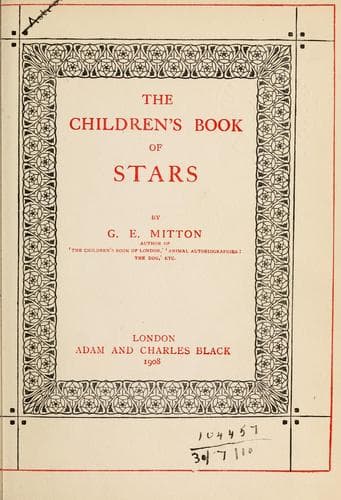
The Children's Book of StarsMitton, G. E. (Geraldine Edith)
Science
The Children's Book of Stars
Mitton, G. E. (Geraldine Edith)
Astronomy -- Juvenile literature
Now, if you look at the sky on the opposite side of the Pole Star from
the Great Bear, you will see a clearly marked capital W made up of five
or six bright stars. This is called Cassiopeia, or the Lady's Chair.
In looking at Cassiopeia you cannot help noticing that there is a zone
or broad band of very many stars, some exceedingly small, which
apparently runs right across the sky like a ragged hoop, and Cassiopeia
seems to be set in or on it. This band is called the Milky Way, and
crosses not only our northern sky, but the southern sky too, thus making
a broad girdle round the whole universe. It is very wonderful, and no
one has yet been able to explain it. The belt is not uniform and even,
but it is here and there broken up into streamers and chips, having the
same appearance as a piece of ribbon which has been snipped about by
scissors in pure mischief; or it may be compared to a great river broken
up into many channels by rocks and obstacles in its course.
The Milky Way is mainly made up of thousands and thousands of small
stars, and many more are revealed by the telescope; but, as we see in
Cassiopeia, there are large bright stars in it too, though, of course,
these may be infinitely nearer to us, and may only appear to us to be in
the Milky Way because they are between us and it.
Now, besides the few constellations that I have mentioned, there are
numbers of others, some of which are difficult to discover, as they
contain no bright stars. But there are certain constellations which
every one should know, because in them may be found some of the
brightest stars, those of the first magnitude. Magnitude means size, and
it is really absurd for us to say a star is of the first magnitude
simply because it appears to us to be large, for, as I have explained
already, a small star comparatively near to us might appear larger than
a greater one further away. But the word 'magnitude' was used when men
really thought stars were large or small according to their appearance,
and so it is used to this day. They called the biggest and brightest
first magnitude stars. Of these there are not many, only some twenty, in
all the sky. The next brightest--about the brightness of the Pole Star
and the stars in the Great Bear--are of the second magnitude, and so
on, each magnitude containing stars less and less bright. When we come
to stars of the sixth magnitude we have reached the limit of our sight,
for seventh magnitude stars can only be seen with a telescope. Now that
we understand what is meant by the magnitude, we can go back to the
constellations and try to find some more.
Public-domain text, read in full here on John Shaqi.
Reviews
Reviews
No reviews yet
Be the first to share your thoughts on this work.
Elsewhere in the archive
Join the Discussion
Join the discussion
Sign in to leave a comment or review.
Sign InorCreate an account