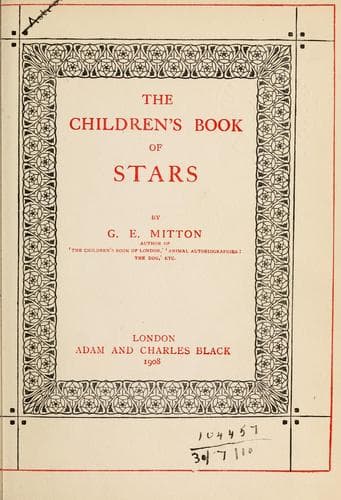
The Children's Book of StarsMitton, G. E. (Geraldine Edith)
Science
The Children's Book of Stars
Mitton, G. E. (Geraldine Edith)
Astronomy -- Juvenile literature
If you draw an imaginary line through the stars forming the belt and
prolong it downwards slantingly, you will see, in the very height of
winter, the brightest star in all the sky, either in the Northern or
Southern Hemisphere. This is Sirius, who stands in a class quite by
himself, for he is many times brighter than any other first magnitude
star. He never rises very high above the horizon here, but on crisp,
frosty nights may be seen gleaming like a big diamond between the
leafless twigs and boughs of the rime-encrusted trees. Sirius is the Dog
Star, and it is perhaps fortunate that, as he is placed, he can be seen
sometimes in the southern and sometimes in the northern skies, so that
many more people have a chance of looking at his wonderful brilliancy,
than if he had been placed near the Pole star. In speaking of the
supreme brightness of Sirius among the stars, we must remember that
Venus and Jupiter, which outrival him, are not stars, but planets, and
that they are much nearer to us. Sirius is so distant that the measures
for parallax make hardly any impression on him, but, by repeated
experiments, it has now been proved that light takes more than eight
years to travel from him to us. So that, if you are eight years old, you
are looking at Sirius as he was when you were a baby!
Not far from the Pleiades, to the left as you face them, are to be
found two bright stars nearly the same size; these are the Heavenly
Twins, or Gemini.
Returning now to the Great Bear, we find, if we draw a line through the
middle and last stars of his tail, and carry it on for a little
distance, we come fairly near to a cluster of stars in the form of a
horseshoe; there is only one fairly bright one in it, and some of the
others are quite small, but yet the horseshoe is distinct and very
beautiful to look at. This is the Northern Crown. The very bright star
not far from it is another first-class star called Arcturus.
To the left of the Northern Crown lies Hercules, which is only mentioned
because near it is the point to which the sun with all his system
appears at present to be speeding.
For other fascinating constellations, such as Leo or the Lion, Andromeda
and Perseus, and the three bright stars by which we recognize Aquila the
Eagle, you must wait awhile, unless you can get some one to point them
out.
Those which you have noted already are enough to lead you on to search
for more.
Perhaps some of you who live in towns and can see only a little strip of
sky from the nursery or schoolroom windows have already found this
chapter dull, and if so you may skip the rest of it and go on to the
next. For the others, however, there is one more thing to know before
leaving the subject, and that is the names of the string of
constellations forming what is called the Zodiac. You may have heard the
rhyme:
Public-domain text, read in full here on John Shaqi.
Reviews
Reviews
No reviews yet
Be the first to share your thoughts on this work.
Elsewhere in the archive
Join the Discussion
Join the discussion
Sign in to leave a comment or review.
Sign InorCreate an account