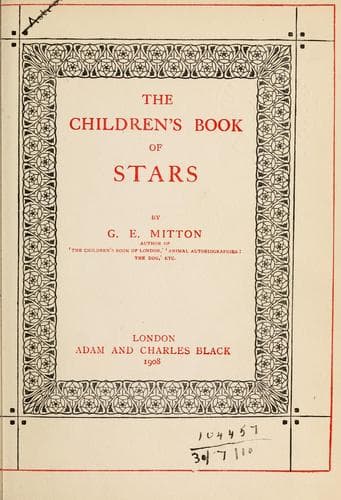
The Children's Book of StarsMitton, G. E. (Geraldine Edith)
Science
The Children's Book of Stars
Mitton, G. E. (Geraldine Edith)
Astronomy -- Juvenile literature
If you draw an imaginary line across the two stars forming the backbone
of the Bear, starting from the end nearest the tail, and continue it
onward for a good distance, you will come to a very bright star called
Capella, which you will know, because near it are three little ones in a
triangle. Now, Capella means a goat, so the small ones are called the
kids. In winter Capella gets high up into the sky, and then there is to
be seen below her a little cluster called the Pleiades. There is nothing
else like this in the whole sky. It is formed of six stars, as it
appears to persons of ordinary sight, and these stars are of the sixth
magnitude, the lowest that can be seen by the naked eye. But though
small, they are set so close together, and appear so brilliant,
twinkling like diamonds, that they are one of the most noticeable
objects in the heavens. A legend tells that there were once seven stars
in the Pleiades clearly visible, and that one has now disappeared. This
is sometimes spoken of as 'the lost Pleiad,' but there does not seem to
be any foundation for the story. In old days people attached particular
holiness or luck to the number seven, and possibly, when they found that
there were only six stars in this wonderful group, they invented the
story about the seventh.
As the Pleiades rise, a beautiful reddish star of the first magnitude
rises beneath them. It is called Aldebaran, and it, as well as the
Pleiades, forms a part of the constellation of Taurus the bull. In
England we can see in winter below Aldebaran the whole of the
constellation of Orion, one of the finest of all the constellations,
both for the number of the bright stars it contains and for the extent
of the sky it covers. Four bright stars at wide distances enclose an
irregular four-sided space in which are set three others close together
and slanting downwards. Below these, again, are another three which seem
to fall from them, but are not so bright. The figure of Orion as drawn
in the old representations of the constellations is a very magnificent
one. The three bright stars form his belt, and the three smaller ones
the hilt of his sword hanging from it.
[Illustration: ORION AND HIS NEIGHBOURS.]
Public-domain text, read in full here on John Shaqi.
Reviews
Reviews
No reviews yet
Be the first to share your thoughts on this work.
Elsewhere in the archive
Join the Discussion
Join the discussion
Sign in to leave a comment or review.
Sign InorCreate an account