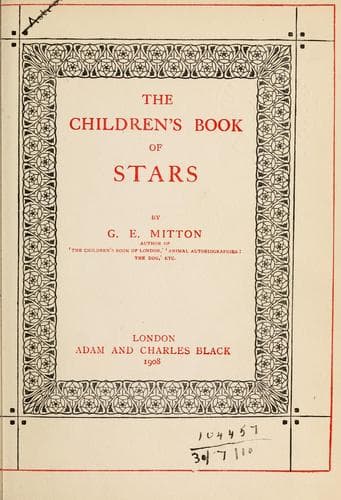
The Children's Book of StarsMitton, G. E. (Geraldine Edith)
Science
The Children's Book of Stars
Mitton, G. E. (Geraldine Edith)
Astronomy -- Juvenile literature
To begin with light, what can we learn from it? We turn at once to our
own great light-giver, the sun, to whom we owe not only all life, but
also all the colour and beauty on earth. It is well known to men of
science that colour lies in the light itself, and not in any particular
object. That brilliant blue cloak of yours is not blue of itself, but
because of the light that falls on it. If you cannot believe this, go
into a room lighted only by gas, and hey, presto! the colour is changed
as if it were a conjuring trick. You cannot tell now by looking at the
cloak whether it is blue or green! Therefore you must admit that as the
colour changes with the change of light it must be due to light, and not
to any quality belonging to the material of the cloak. But, you may
protest, if the colour is solely due to light, and light falls on
everything alike, why are there so many colours? That is a very fair
question. If the light that comes from the sun were of only one
colour--say blue or red--then everything would be blue or red all the
world over. Some doors in houses are made with a strip of red or blue
glass running down the sides. If you have one in your house like that,
go and look through it, and you will see an astonishing world made up of
different tones of the same colour. Everything is red or blue, according
to the colour of the glass, and the only difference in the appearance of
objects lies in the different shades, whether things are light or dark.
This is a world as it might appear if the sun's rays were only blue or
only red. But the sun's light is not of one colour only, fortunately for
us; it is of all the colours mixed together, which, seen in a mass, make
the effect of white light. Now, objects on earth are only either seen by
the reflected light of the sun or by some artificial light. They have no
light of their own. Put them in the dark and they do not shine at all;
you cannot see them. It is the sun's light striking on them that makes
them visible. But all objects do not reflect the light equally, and this
is because they have the power of absorbing some of the rays that strike
on them and not giving them back at all, and only those rays that are
given back show to the eye. A white thing gives back all the rays, and
so looks white, for we have the whole of the sun's light returned to us
again. But how about a blue thing? It absorbs all the rays except the
blue, so that the blue rays are the only ones that come back or rebound
from it again to meet our eyes, and this makes us see the object blue;
and this is the case with all the other colours. A red object retains
all rays except the red, which it sends back to us; a yellow object
gives back only the yellow rays, and so on. What an extraordinary and
mysterious fact! Imagine a brilliant flower-garden in autumn. Here we
have tall yellow sunflowers with velvety brown centres, clustering pink
and crimson hollyhocks, deep red and bright yellow peonies, slender
Public-domain text, read in full here on John Shaqi.
Reviews
Reviews
No reviews yet
Be the first to share your thoughts on this work.
Elsewhere in the archive
Join the Discussion
Join the discussion
Sign in to leave a comment or review.
Sign InorCreate an account