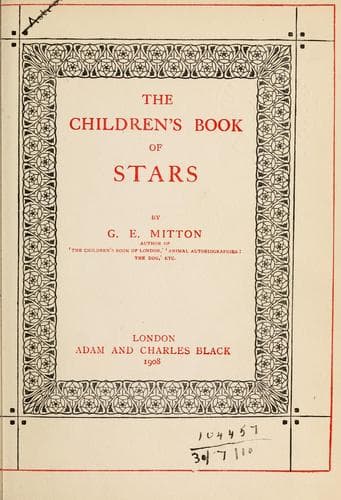
The Children's Book of StarsMitton, G. E. (Geraldine Edith)
Science
The Children's Book of Stars
Mitton, G. E. (Geraldine Edith)
Astronomy -- Juvenile literature
fairy-like Japanese anemones, great bunches of mauve Michaelmas daisies,
and countless others, and mingled with all these are many shades of
green. Yet it is the light of the sun alone that falling on all these
varied objects, makes that glorious blaze of colour; it seems
incredible. It may be difficult to believe, but it is true beyond all
doubt. Each delicate velvety petal has some quality in it which causes
it to absorb certain of the sun's rays and send back the others, and its
colour is determined by those it sends back.
Well then how infinitely varied must be the colours hidden in the sun's
light, colours which, mixed all together, make white light! Yes, this is
so, for all colours that we know are to be found there. In fact, the
colours that make up sunlight are the colours to be seen in the rainbow,
and they run in the same order. Have you ever looked carefully at a
rainbow? If not, do so at the next chance. You will see it begins by
being dark blue at one end, and passes through all colours until it gets
to red at the other.
We cannot see a rainbow every day just when we want to, but we can see
miniature rainbows which contain just the same colours as the real ones
in a number of things any time the sun shines. For instance, in the
cut-glass edge of an inkstand or a decanter, or in one of those
old-fashioned hanging pieces of cut-glass that dangle from the
chandelier or candle-brackets. Of course you have often seen these
colours reflected on the wall, and tried to get them to shine upon your
face. Or you have caught sight of a brilliant patch of colour on the
wall and looked around to see what caused it, finally tracing it to some
thick edge of shining glass standing in the sunlight. Now, the cut-glass
edge shows these colours to you because it breaks up the light that
falls upon it into the colours it is made of, and lets each one come out
separately, so that they form a band of bright colours instead of just
one ray of white light.
This is perhaps a little difficult to understand, but I will try to
explain. When a ray of white light falls on such a piece of glass, which
is known as a prism, it goes in as white light at one side, but the
three-cornered shape of the glass breaks it up into the colours it is
made of, and each colour comes out separately at the other side--namely,
from blue to red--like a little rainbow, and instead of one ray of white
light, we have a broad band of all the colours that light is made of.
Public-domain text, read in full here on John Shaqi.
Reviews
Reviews
No reviews yet
Be the first to share your thoughts on this work.
Elsewhere in the archive
Join the Discussion
Join the discussion
Sign in to leave a comment or review.
Sign InorCreate an account