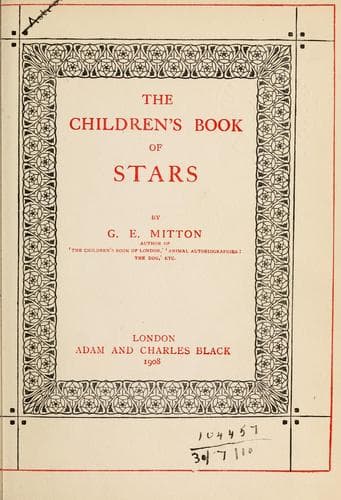
The Children's Book of StarsMitton, G. E. (Geraldine Edith)
Science
The Children's Book of Stars
Mitton, G. E. (Geraldine Edith)
Astronomy -- Juvenile literature
We have therefore come to the conclusion that there are in this
astonishing universe numbers of gloriously coloured suns, some of which
apparently lie close together. What follows? Why, we want to know, of
course, if these stars are really pairs connected with each other, or if
they only appear so by being in the same line of sight, though one is
infinitely more distant than the other. And that question also has been
answered. There are now known thousands of cases in which stars,
hitherto regarded as single, have been separated into two, or even more,
by the use of a telescope. Of these thousands, some hundreds have been
carefully investigated, and the result is that, though there are
undoubtedly some in which the connexion is merely accidental, yet in by
far the greater number of cases the two stars thus seen together have
really some connexion which binds them to one another; they are
dependent on one another. This has been made known to us by the working
of the wonderful law of gravitation, which is obeyed throughout the
whole universe. We know that by the operation of this law two mighty
suns will be drawn toward each other with a certain pull, just as surely
as we know that a stone let loose from the hand will fall upon the
earth; so by noting the effect of two mighty suns upon each other many
facts about them may be found out. By the most minute and careful
measurements, by the use of the spectroscope, and by every resource
known to science, astronomers have, indeed, actually found out with a
near approach to exactness how far some of these great suns lie from
each other, and how large they are in comparison with one another.
The very first double star ever discovered was one which you have
already seen, the middle one in the tail of the Great Bear. If you look
at it you will be delighted to find that you can see a wee star close to
it, and you will think you are looking at an example of a double star
with your very own eyes; but you will be wrong, for that wee star is
separated by untold distances from the large one to which it seems so
near. In fact, any stars which can be seen to be separate by the naked
eye must lie immeasurably far apart, however tiny seems the space
between them. Such stars may possibly have some connexion with each
other, but, at any rate in this case, such a connexion has not been
proved. No, the larger star itself is made up of two others, which can
only be seen apart in a telescope. Since this discovery double stars
have been plentifully found in every part of the sky. The average space
between such double stars as seen from our earth is--what do you think?
It is the width of a single hair held up thirty-six feet from our eyes!
This could not, of course, be seen without the use of a telescope or
opera-glasses. It serves to give some impression of star distances when
we think that the millions and millions of miles lying between those
stars have shrunk to that hair's-breadth seen from our point of view.
Public-domain text, read in full here on John Shaqi.
Reviews
Reviews
No reviews yet
Be the first to share your thoughts on this work.
Elsewhere in the archive
Join the Discussion
Join the discussion
Sign in to leave a comment or review.
Sign InorCreate an account