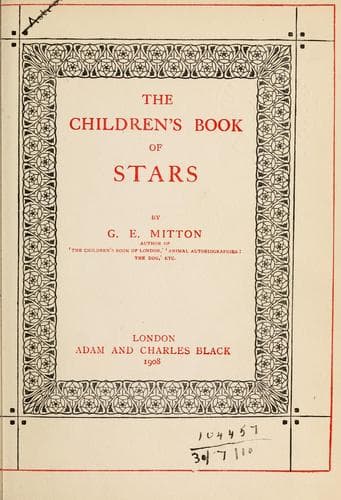
The Children's Book of StarsMitton, G. E. (Geraldine Edith)
Science
The Children's Book of Stars
Mitton, G. E. (Geraldine Edith)
Astronomy -- Juvenile literature
Twin stars circle together round a common centre of gravity, and are
bound by the laws of gravitation just as the planets are. Our sun is a
solitary star, with no companion, and therefore such a state of things
seems to us to be incredible. Fancy two gigantic suns, one topaz-yellow
and the other azure-blue, circling around in endless movement! Where in
such a system would there be room for the planets? How could planets
exist under the pull of two suns in opposite directions? Still more
wonders are unfolded as the inquiry proceeds. Certain irregularities in
the motions of some of these twin systems led astronomers to infer that
they were acted upon by another body, though this other body was not
discernible. In fact, though they could not see it, they knew it must be
there, just as Adams and Leverrier knew of the existence of Neptune,
before ever they had seen him, by the irregularities in the movements of
Uranus. As the results showed, it was there, and was comparable in size
to the twin suns it influenced, and yet they could not see it. So they
concluded this third body must be dark, not light-giving like its
companions. We are thus led to the strange conclusion that some of these
systems are very complicated, and are formed not only of shining suns,
but of huge dark bodies which cannot be called suns. What are they,
then? Can they be immense planets? Is it possible that life may there
exist? No fairy tale could stir the imagination so powerfully as the
thought of such systems including a planetary body as large or larger
than its sun or suns. If indeed life exists there, what a varied scene
must be presented day by day! At one time both suns mingling their
flashing rays may be together in the sky; at another time only one
appears, a yellow or blue sun, as the case may be. The surface of such
planets must undergo weird transformations, the foliage showing one day
green, the next yellow, and the next blue; shadows of azure and orange
will alternate! But fascinating as such thoughts are, we can get no
further along that path.
Public-domain text, read in full here on John Shaqi.
Reviews
Reviews
No reviews yet
Be the first to share your thoughts on this work.
Elsewhere in the archive
Join the Discussion
Join the discussion
Sign in to leave a comment or review.
Sign InorCreate an account