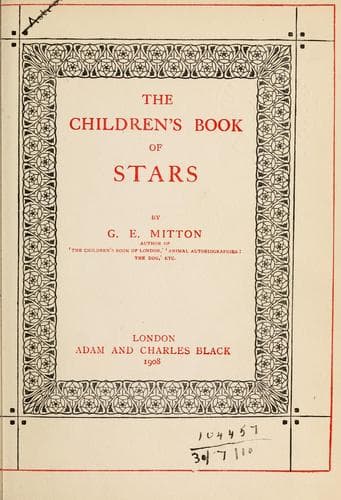
The Children's Book of StarsMitton, G. E. (Geraldine Edith)
Science
The Children's Book of Stars
Mitton, G. E. (Geraldine Edith)
Astronomy -- Juvenile literature
In this chapter we have learnt an altogether new fact--the fact that the
hosts of heaven comprise not only those shining stars we are accustomed
to see, but also dark bodies equally massive, and probably equally
numerous, which we cannot see. In fact, the regions of space may be
strewn with such dark bodies, and we could have no possible means of
discovering them unless they were near enough to some shining body to
exert an influence upon it. It is not with his eyes alone, or with his
senses, man knows of the existence of these great worlds, but often
solely by the use of the powers of his mind.
CHAPTER XV
TEMPORARY AND VARIABLE STARS
It is a clear night, nearly all the world is asleep, when an astronomer
crosses his lawn on his way to his observatory to spend the dark hours
in making investigations into profound space. His brilliant mind,
following the rays of light which shoot from the furthest star, will
traverse immeasurable distances, while the body is forgotten. Just
before entering the observatory he pauses and looks up; his eye catches
sight of something that arrests him, and he stops involuntarily. Yet any
stranger standing beside him, and gazing where he gazes, would see
nothing unusual. There is no fiery comet with its tail stretching across
from zenith to horizon, no flaming meteor dashing across the darkened
sky. But that there is something unusual to be seen is evident, for the
astronomer breathes quickly, and after another earnest scrutiny of the
object which has attracted him, he rushes into the observatory, searches
for a star-chart, and examines attentively that part of the sky at
which he has been gazing. He runs his finger over the chart: here and
there are the well-known stars that mark that constellation, but here?
In that part there is no star marked, yet he knows, for his own eyes
have told him but a few moments ago, that here there is actually blazing
a star, not large, perhaps, but clear enough to be seen without a
telescope--a star, maybe, which no eye but his has yet observed!
He hurries to his telescope, and adjusts it so as to bring the stranger
into the field of view. A new star! Whence has it come? What does it
mean?
Public-domain text, read in full here on John Shaqi.
Reviews
Reviews
No reviews yet
Be the first to share your thoughts on this work.
Elsewhere in the archive
Join the Discussion
Join the discussion
Sign in to leave a comment or review.
Sign InorCreate an account