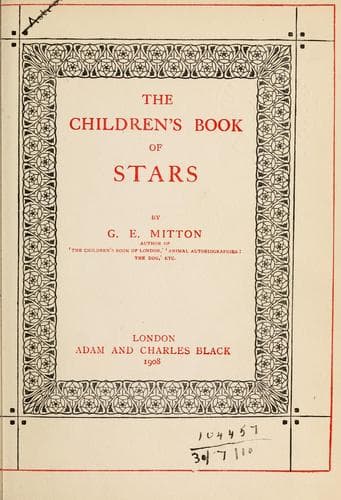
The Children's Book of StarsMitton, G. E. (Geraldine Edith)
Science
The Children's Book of Stars
Mitton, G. E. (Geraldine Edith)
Astronomy -- Juvenile literature
To turn from fancy to facts, we find that telescope and spectroscope
have supplied us with quite enough matter for wonder without calling
upon imagination. We have discovered that many of the stars which seem
to shine with a pure single light are double, and many more consist not
only of two stars, but of several, some of which may be dark bodies. The
Pole Star was long known to be double, and is now discovered to have a
third member in its system. These multiple systems vary from one
another in almost every case. Some are made up of a mighty star and a
comparatively small one; others are composed of stars equal in
light-giving power--twin suns. Some progress swiftly round their orbits,
some go slowly; indeed, so slowly that during the century they have been
under observation only the very faintest sign of movement has been
detected; and in other systems, which we are bound to suppose double,
the stars are so slow in their movements that no progress seems to have
been made at all.
The star we know as the nearest to us in the heavens, Alpha Centauri, is
composed of two very bright partners, which take about eighty-seven
years to traverse their orbit. They sometimes come as near to each other
as Saturn is to the sun. In the case of Sirius astronomers found out
that he had a companion by reason of his irregularities of movement
before they discovered that companion, which is apparently a very small
star, only to be discerned with good telescopes. But here, again, it
would be unwise to judge only by what we see. Though the star appears
small, we know by the influence it exercises on Sirius that it is very
nearly the same size as he is. Thus we judge that it is poor in
light-giving property; in fact, its shining power is much less than that
of its companion, though its size is so nearly equal. This is not
wonderful, for Sirius's marvellous light-giving power is one of the
wonders of the universe; he shines as brilliantly as twenty-nine or
thirty of our suns!
In some cases the dark body which we cannot see may even be larger than
the shining one, through which alone we can know anything of it. Here we
have a new idea, a hint that in some of these systems there may be a
mighty earth with a smaller sun going round it, as men imagined our sun
went around the earth before the real truth was found out.
So we see that, when we speak of the stars as suns comparable with our
sun, we cannot think of them all as being exactly on the same model.
There are endless varieties in the systems; there are solitary suns like
ours which may have a number of small planets going round them, as in
the solar system; but there are also double suns going round each other,
suns with mighty dark bodies revolving round them which may be planets,
and huge dark bodies with small suns too. Every increase of knowledge
opens up new wonders, and the world in which we live is but one kind of
world amid an infinite number.
Public-domain text, read in full here on John Shaqi.
Reviews
Reviews
No reviews yet
Be the first to share your thoughts on this work.
Elsewhere in the archive
Join the Discussion
Join the discussion
Sign in to leave a comment or review.
Sign InorCreate an account