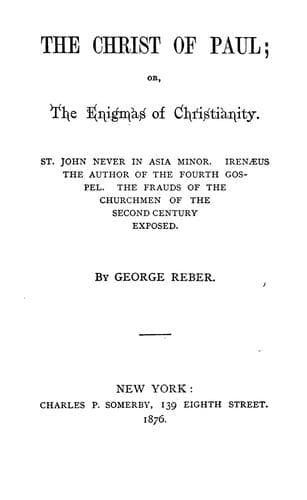
The Christ of Paul; Or, The Enigmas of ChristianityReber, George
Religion
The Christ of Paul; Or, The Enigmas of Christianity
Reber, George
Bible. New Testament -- Controversial literature; Church history -- Primitive and early church, ca. 30-600 -- Controversial literature
Here we have a historian of the right kind, living so near the time that
he must have seen and conversed with those who had seen and known Christ
and his disciples. How are we to regard his silence? Had Christ been the
character which many suppose he was, a teacher endowed beyond all other
men, with a divine genius to declare the doctrines which are to govern
man in his relations towards the Creator and towards each other, we can
well understand why, in A.D. 93, when Josephus wrote the history of the
Jews, he failed to notice him. His ministry extended through a period of
only one year, at a time when the Jewish people were chafing under the
yoke of the Romans, and were preparing for a final struggle with the
conquerors. At such a time, the presence of such a person as Christ,
who taught men to forgive their enemies, to love their neighbors as
themselves, and to cultivate feelings which dispose mankind to peace
and charity, would most likely pass unnoticed. If Christ was more than
a great teacher--if he were the second person in the Godhead, who
condescended to visit the earth to instruct mankind, and while here
performed the wonderful works spoken of in the Gospels, then there is no
way in which we can account for the silence of the Jewish historian. We
are forced to admit that the Son of God, who took up his abode among
men to convince and instruct them, failed to make his presence known and
felt so as to attract the notice of him who undertook to give a minute
account of what happened at the time, and in the country where he
preached and taught.
The attempt in the fourth century to force into history, between the
regular course of events, a passage intended to break the force of total
unconsciousness on the part of Josephus that there was such a person
as Christ, to the eye of the critic is infinitely more damaging than
complete silence. A quarrel, which led to a sedition, sprang up in
Jerusalem, about the use made by Pilate of sacred money, to bring
water into the city. "_About the same time, also, another_ sad calamity
happened, which put the Jews into disorder." A Roman woman called
Paulina, through the connivance of some of the gods of Isis, was seduced
by a person of the name of Mundus. (_Antiq_., book xviii. chap. 3.)
Between these two events, is wedged, or forced in, a paragraph which
contains all the great historian has to say of Christ, and the events of
his life. Twenty-nine lines are taken to tell about the troubles
growing out of the misapplication of the sacred money; one hundred and
thirty-one about Paulina and her misfortunes, and _sixteen_ are all that
the historian requires to inform us of all he knows about Christ. Much
better had he said nothing.
Public-domain text, read in full here on John Shaqi.
Reviews
Reviews
No reviews yet
Be the first to share your thoughts on this work.
Elsewhere in the archive
Join the Discussion
Join the discussion
Sign in to leave a comment or review.
Sign InorCreate an account