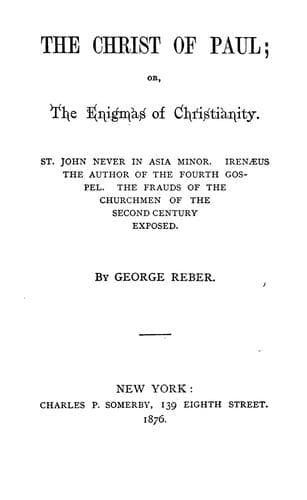
The Christ of Paul; Or, The Enigmas of ChristianityReber, George
Religion
The Christ of Paul; Or, The Enigmas of Christianity
Reber, George
Bible. New Testament -- Controversial literature; Church history -- Primitive and early church, ca. 30-600 -- Controversial literature
If Josephus makes no mention of Christ and his miracles, where must we
look? It is in vain to search among the writers of Greece and Rome. Out
of the nine reasons given by Dr. Lardner for believing the passage from
Josephus in relation to Christ spurious, the first is sufficient: it was
never quoted, or referred to, by any writer previous to _Eusebius_, who
wrote in the fourth century.
CHAPTER XXV.
Epistle of Paul to the Hebrews.
THIS epistle has been the source of more controversy than any other book
of the New Testament. It has been the cause of much useless labor
and unprofitable research. In the first place, was Paul the author?
Tertullian ascribes it to Barnabas; Grotius to St. Luke, and Luther the
reformer thought it was written by Apollos, mentioned in the Acts; but
the testimony of ecclesiastical antiquity is all in favor of Paul as the
author. Allusions are made to it in the epistles of Ignatius about A. D.
107. It is also referred to by Polycarp, Bishop of Smyrna in the year A.
D. 108.
Internal evidence, supplied by the epistle itself, is conclusive that
Paul was the writer. No one better than he understood the veneration in
which the Levitical law was held by the Jewish people, and the tenacity
with which they adhered to it. As he believed that this law had passed
away, and that the Lord had made a new covenant with the Jewish nation,
it was natural for him to labor to open the eyes of his countrymen,
and bring them under the light of the new dispensation. It was for this
reason, when he entered into a place for the first time, that he always
began to teach in the synagogue. If Paul wrote to the Hebrews at all, it
would be just such an epistle as the one ascribed to him, except
certain portions, which were clearly written after the Pauline period of
Christianity had passed away.
Again, it has been a question as to the language in which this epistle
was first written. At the time of Paul, the original Hebrew was
understood by few, and had ceased to be the language of the Jews. The
original Hebrew was broken in upon by several dialects--such as the
East Aramæan, or Chaldee, and the West Aramæan, or Syriac. The universal
language of the day was Greek, and no doubt Paul adopted it in writing
to the Hebrews, who were dispersed over Europe, Asia, and parts of
Africa.
Public-domain text, read in full here on John Shaqi.
Reviews
Reviews
No reviews yet
Be the first to share your thoughts on this work.
Elsewhere in the archive
Join the Discussion
Join the discussion
Sign in to leave a comment or review.
Sign InorCreate an account