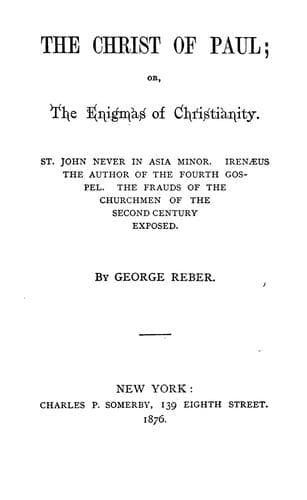
The Christ of Paul; Or, The Enigmas of ChristianityReber, George
Religion
The Christ of Paul; Or, The Enigmas of Christianity
Reber, George
Bible. New Testament -- Controversial literature; Church history -- Primitive and early church, ca. 30-600 -- Controversial literature
On the fifth, sixth, seventh and eighth verses of the second chapter,
Paul declares that to angels "is given the government of the world to
come;" and to man, who was made but _little lower than the angels_, was
consigned the government of the earth. All men, according to Paul, like
Jesus, were born but little lower than the angels--and Christ by him is
put on a level with all humanity. It is evident that the first chapter,
as written by Paul, has been suppressed, and the one which has descended
to us is made to take its place. It is not possible that Paul wrote the
first and second chapters as they now stand. In the one case Christ is
made _more_ than the angels; and in the other case he is made _less_. In
the one case he is the Creator of the world, "_upholding all things by
the word of his power_;" in the other he is a High Priest of the order
of Melchisedec, and one of the descendants of Abraham. In the first
chapter he formed the world, and in the third chapter it is said,
"He who built all things is God." The doctrines here declared are
unreconcilable, but it is not difficult to distinguish between those of
Paul and those of the men of the second century.
Paul speaks of three orders of the priesthood: that of Melchisedec, that
under the Levitical law, and that under the new covenant, with Christ
at the head. What was the character of the priesthood of the order
of Melchisedec, Paul does not say--nor do we know where to look for
information on the subject. He was "without father, without mother,
without descent, having neither beginning of days, nor end of life; but
made like _unto the Son of God_: abideth a priest continually." (Chap.
vii. 3.) When we are informed in the same chapter that Christ is a
priest after the order of Melchisedec, "who is made, not after the _law
of a carnal commandment_, but after the power of an endless life" (ver.
16), we detect the insidious and subtle poison of the Johannian school.
Here we have a Logos, who was in the beginning, and who would continue
through all time, which could never be true of any of the descendants
of Abraham. The priesthood under the Levitical law, Paul claimed, had
passed away, and was succeeded by a much better one with Christ as
its head. The last was superior to the old because it would "continue
forever, an unchangeable priesthood." (Chap. vii. 24.) In this new and
better dispensation, Christ is as superior to Moses and Aaron, as the
new covenant is superior to the old. Christ is called a High Priest, "a
minister of the sanctuary, and of the true tabernacle, which the Lord
pitched, and not man." (Chap. viii. 2.)
Public-domain text, read in full here on John Shaqi.
Reviews
Reviews
No reviews yet
Be the first to share your thoughts on this work.
Elsewhere in the archive
Join the Discussion
Join the discussion
Sign in to leave a comment or review.
Sign InorCreate an account