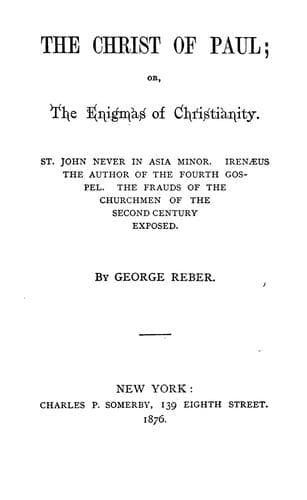
The Christ of Paul; Or, The Enigmas of ChristianityReber, George
Religion
The Christ of Paul; Or, The Enigmas of Christianity
Reber, George
Bible. New Testament -- Controversial literature; Church history -- Primitive and early church, ca. 30-600 -- Controversial literature
As the initiatory formula usual in the epistles of Paul is wanting in
this, it has been questioned whether it was really an epistle, or only a
discourse intended for the general reader. The want of the usual formula
can be easily accounted for, when the mind becomes convinced that the
first chapter is not the production of Paul. That it was written as it
now stands by the forgers of the second century admits of no doubt. The
design of the writer is exposed in the very first and second verses of
the first chapter. "God, who at sundry times and in divers manners spake
in time past unto the fathers by the prophets, hath in these last days
spoken unto us by his Son, whom he hath appointed heir of all things,
_by whom also he made the worlds_."
Here Christ is made the Creator by whom the worlds were made. Again:
"Who being the brightness of his glory, and the _express image of his
person, and upholding all things by the word of his power_, when he had
by himself purged our sins, sat down on the right hand of the Majesty
on high; being made so much _better than the angels_, as he hath by
_inheritance_ obtained a more excellent name than they. For unto which
of the angels said he at any time, Thou art my Son, this day have I
begotten thee? And again, I will be to him a Father, and he shall be
to me a Son? And again, when he bringeth in the first-begotten into the
world, he saith, And let all the angels of God worship him." (_Heb_. i.
3-6.)
Here we find condensed into a few verses, and declared in the most
pointed language, the _Godship_ of Christ, first proclaimed by the
men of the second century, and which is in direct conflict with the
remainder of the Epistle, and with what Paul taught during his whole
life.
Commencing at the ninth verse of the second chapter, Paul says: "But
we see Jesus, who was made a little _lower_ than the angels for the
suffering of death, crowned with glory and honor; that he by the grace
of God should taste death for every man." "For verily he took not on him
the nature of angels; but he took on him the seed of Abraham." (Chap.
ii. 16.) "Wherefore, holy brethren, partakers of the heavenly calling,
consider the Apostle and _High Priest_ of our profession, Christ Jesus;
who was faithful to him who appointed him, as also Moses was faithful
in all his house. For _this man_ was accounted worthy of more glory than
Moses, inasmuch as he who hath builded the house hath more honor than
the house. For every house is builded by some man; _but he that built
all things is God_." (Chap. iii. 1-5.)
Public-domain text, read in full here on John Shaqi.
Reviews
Reviews
No reviews yet
Be the first to share your thoughts on this work.
Elsewhere in the archive
Join the Discussion
Join the discussion
Sign in to leave a comment or review.
Sign InorCreate an account