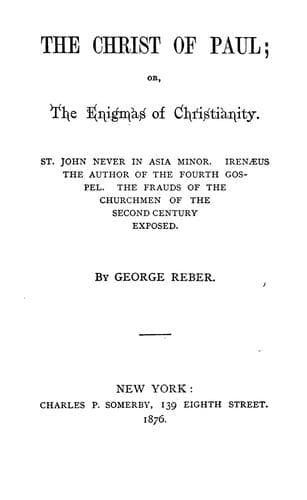
The Christ of Paul; Or, The Enigmas of ChristianityReber, George
Religion
The Christ of Paul; Or, The Enigmas of Christianity
Reber, George
Bible. New Testament -- Controversial literature; Church history -- Primitive and early church, ca. 30-600 -- Controversial literature
The temple of Jerusalem being destroyed by Nebuchadnezzar, the
Samaritans proposed to join the Jews after their captivity in rebuilding
it; but the Jews refused the coalition. (_Ezra_ iv. 1-3.) This gave rise
to other causes of dispute, until the most inveterate hatred grew up
between the two peoples. At length, by permission of Alexander the
Great, the Samaritans erected a temple at Mount Gerizim, in opposition
to the one at Jerusalem. The same worship was observed in both cities,
and both people avoided the idolatry of surrounding nations. All the
followers of Moses in Judea shared alike in the calamities which befell
the Jewish people; so all shared a common belief that God would at some
time, by the hand of a deliverer, restore to them all they had lost.
If by the hand of Cyrus the power of the Assyrian empire had been torn
down, the Temple rebuilt, and the Jews and Samaritans placed back in
their homes in Judea; so, if some like calamity should befall them,
the same hand would again restore them to liberty and the land of their
inheritance. The Jews and Samaritans, though divided on some things,
were alike the chosen people of God, and the promises made to one were
made to both. At the time Christ made his appearance in Samaria, the
people of that country had settled convictions as to what they might
expect from the promises made to them by Jehovah through Moses, their
great lawgiver and prophet. These convictions, like the concretion of
ages, had solidified, and made up the Jewish and Samaritan character.
Whatever might befall them, they had no expectations of a spiritual
deliverer of any kind. They recognized no spiritual bondage growing out
of the sins of the first parents, like the believers in Christianity,
for Moses taught nothing of the kind. A personal sacrifice, like that of
Christ, to save men from the condemnation of a broken law, never entered
into the mind of either Jew or Samaritan. Neither was cosmopolitan, and
with them a deliverer was a deliverer to the Jews and not the Gentiles.
After Christ had convinced the woman at the well that he was a prophet,
by telling her past life, she is made to say: "I know that Messiah
cometh which is called Christ; when he is come he will tell us all
things. Jesus saith unto her, I that speak unto thee am he." It is said
that the woman believed; if so, did she understand him? With Christ,
he was the Son of God, equal with the Father; was with him in the
beginning, and by him the universe was made--_he was the Creator_. We
ask again, did the woman believe in such a Messiah, and did she believe
that he who spoke to her, and told her how many husbands she had had,
was that august Being? If there is room in the breast of any people for
a hope or expectation of such a person as Christ claimed to be, not a
shade of either could be found in the hearts of the followers of Moses.
Let a belief in such a Being have made its way into the Jewish mind, and
Public-domain text, read in full here on John Shaqi.
Reviews
Reviews
No reviews yet
Be the first to share your thoughts on this work.
Elsewhere in the archive
Join the Discussion
Join the discussion
Sign in to leave a comment or review.
Sign InorCreate an account