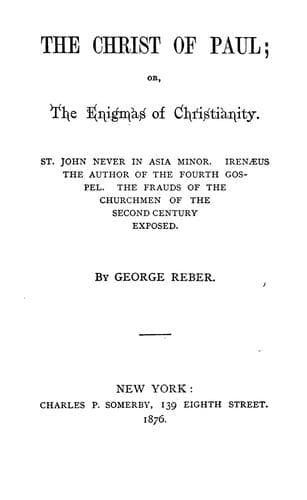
The Christ of Paul; Or, The Enigmas of ChristianityReber, George
Religion
The Christ of Paul; Or, The Enigmas of Christianity
Reber, George
Bible. New Testament -- Controversial literature; Church history -- Primitive and early church, ca. 30-600 -- Controversial literature
between him and his disciples before the crucifixion is omitted. This
miraculous conversion of the elements has been one of the holy mysteries
of the Church for ages past. It has been the bigot's wand. Millions have
fallen down before the Host. It led the crusades. The fair fields of
Europe and Asia have been whitened by the bones of its victims. In fine,
it has been the armory in which fanaticism has forged her most fatal
and dangerous weapons. With John, the body of Christ is never dead--the
grave cannot hold it; but it exists in a mysterious union with the
Church, so that every time the devout believer eats of the bread, or
touches the sacred cup to his lips, he partakes of the flesh and drinks
the blood of the Son of God. Such is the dogma which took its rise in
the last half of the second century, the offspring of a bitter, heated
controversy which demands that reason be strangled to make room for
faith. It is the fate of this dogma, as it is of all like it, to
be associated with others equally false and absurd. It can have no
fellowship with truth. Speaking of Christ, John says: "The same was in
the beginning with God. All things were made by him, and without him
was not anything made that was made." (Chap. i. 2, 3.) Christ says of
himself: "For I came down from heaven, not to do mine own will, but the
will of him that sent me." (Chap. vi. 38.) He was on earth thirty-three
years. In what business was this creator of worlds engaged for thirty
years of this time? If anything, so far as we can know, it was the
business of a carpenter. Did he do his Heavenly Father's business all
this time? This is what he says himself he was sent to do. The first
proof he gave of the power of a god, while here, was at Cana. It
was here that he first manifested forth his glory, and inspired his
disciples with faith. The first three Gospels leave Christ to his
humanity to the time the angels took charge of him, and subject him,
like other mortals, to human employments. In John, a god with power to
create worlds is bound up in the fate of mortals for thirty years, and
only escapes thralldom when the spell is broken at the marriage feast.
Would he, who was with God in the beginning, whose word was sufficient
to create worlds, submit to a fate like this?
The interview between Christ and the woman of Samaria affords abundant
evidence of the spurious character of the fourth Gospel, and that the
writer was some Greek who was ignorant of the religion of Moses and the
Jews.
Public-domain text, read in full here on John Shaqi.
Reviews
Reviews
No reviews yet
Be the first to share your thoughts on this work.
Elsewhere in the archive
Join the Discussion
Join the discussion
Sign in to leave a comment or review.
Sign InorCreate an account