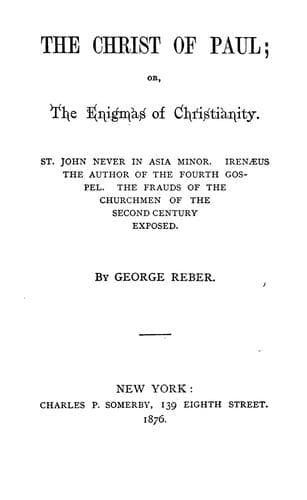
The Christ of Paul; Or, The Enigmas of ChristianityReber, George
Religion
The Christ of Paul; Or, The Enigmas of Christianity
Reber, George
Bible. New Testament -- Controversial literature; Church history -- Primitive and early church, ca. 30-600 -- Controversial literature
In talking to the Jews, Christ is made to say: "For had ye believed
Moses, ye would have believed me: for he wrote of me. But if ye believe
not his writings, how shall ye believe my words?" (_John_ v. 46,47.)
Christ here undertakes to make the Jews believe that he was the one
who had been foreseen and spoken of in ages past, and especially by the
great prophet of the Hebrew people. Had any Jew in the time of Moses
set up the claim that at some future day there would arise one among his
people who would be equal with God, but who would suffer death at their
hands, as a ransom for the salvation not only of the Jews but of the
Gentiles, he would have ordered that such a prophet be stoned to death.
By him and \ the Jews no such Saviour was expected or required. Adam and
Eve were the first to break the law, but God pronounced judgment upon
them before they left the Garden. The earth was cursed with thorns and
thistles, for Adam's sake. By the sweat of his brow he was bound to eat
of its fruits in sorrow all his days. Upon Eve were imposed the pains
and sufferings of childbirth, and the duty of obedience. All this
endured, both were to return to the dust from whence they came. This was
all the punishment and all the atonement God demanded. He asked no more.
With Moses, death was the end of punishment. Those who committed the
first sin made their own atonement, and so have all their descendants,
in the eyes of Moses and the Jews. "Had ye believed in Moses, ye would
have believed in me." Reverse this, and we have the exact truth: If ye
believe in Moses, it is impossible to believe in me. How could they?
"Moses wrote of me." What did he write? To connect Christ with prophecy,
language of the most indefinite character is selected from all parts of
the Hebrew scriptures. "The seed of the woman shall bruise the serpent's
head." Christ of the fourth Gospel is not of the seed of the woman.
"_The Word was made flesh?_" and "was not born of blood, nor the will
of the flesh, nor the will of man, but of God." "The scepter shall not
depart from Judah, nor a lawgiver from between his feet, until Shiloh
come." (_Gen_, xlix. 10). The Jews ceased to be an independent people,
and the scepter departed from Judah at the time Pompey invaded the
country, seized upon the Temple, deposed Aristobulus, the high priest,
and put Hyrcanus in his place. (Josephus, _Wars_, Book I. chap. vii.
sec. 6.) He deprived the Jews of all their conquests, restored the
conquered, and placed Syria, together _with Judea_ and the country as
far as Egypt and Euphrates, under the command of Scaurus. (Ibid, sec. 7.)
Public-domain text, read in full here on John Shaqi.
Reviews
Reviews
No reviews yet
Be the first to share your thoughts on this work.
Elsewhere in the archive
Join the Discussion
Join the discussion
Sign in to leave a comment or review.
Sign InorCreate an account