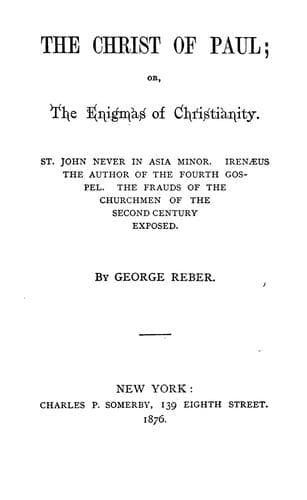
The Christ of Paul; Or, The Enigmas of ChristianityReber, George
Religion
The Christ of Paul; Or, The Enigmas of Christianity
Reber, George
Bible. New Testament -- Controversial literature; Church history -- Primitive and early church, ca. 30-600 -- Controversial literature
In view of these events, Josephus bitterly laments the results, and
says: "_We lost our liberty', and became subject to the Romans_, and
were deprived of that country which we had gained by our arms from the
Syrians, and were compelled to restore it to the Syrians. Moreover, the
Romans exacted of us, in a little time, above ten thousand talents."
(Josephus, _Antiquities_, Book XIV. ch. iv. sec. v.) When did the Jews,
after the conquest of Pompey, shake off the yoke of the Romans? Between
his conquest and the birth of Christ at least sixty-seven years had
intervened. In the meantime Caesar crossed the Rubicon, was assassinated
in the senate; the empire was distracted by civil wars; Mark Antony and
Augustus tried the fortune of battle with Brutus and Cassius, on the
field at Philippi, and the first of the Roman emperors had nearly
completed a long reign of four-and-forty years. When Christ was born,
the scepter had departed from Judea, and the Jews were a nation of
slaves.
Space will not allow us to pursue this subject farther. Throughout
the Gospel of John we discover the most studied and labored effort to
connect Christ with the religion of Moses, so that it may appear that in
himself he is only the response to the many prophesies contained in the
Hebrew scriptures. This Gospel is full of instances where the Jews, upon
Christ's bare word--and sometimes not even that--gave up everything, and
followed him, even to the cross. The day following the baptism, as John
stood by the side of the disciples, Jesus walked by, when the Baptist
exclaimed: "_Behold the Lamb of God!_" This was sufficient to induce two
of the disciples to follow Christ, and one of them was so carried away
that he hunted up his brother, who was Peter, and told him they _had
found the Messiah, who was the Christ_. On the next day, Christ went
to Galilee, and found Philip, whom he directed to follow him; and soon
Philip found Nathaniel, and told him, "We have found him of whom _Moses,
in the law, and the prophets, did write_." They had found no such
thing. The conversion of Paul formed a new era in religious history. We
may well say, that when he left Judaism, he left the twelve disciples
behind him, for they could neither climb over or break down the wall of
circumcision which separated the Jews from the Gentiles. Paul quarreled
with and then left them, but took along with him enough of the Mosaic
faith to keep up a connection between the old and new religion, so
that we can trace the features of the child in those of the parent. He
carried with him _Monotheism_, but it was qualified in the glare of his
vision at Damascus so that, in some sense, Christ was the Son of
God. Here was a clear departure from Moses, for which the Jews always
despised him. Then followed Paul's tug with the Greeks. In spite of him,
they established a dual government in Heaven. _The Son was equal with
the Father_, At this point there should have been an eternal separation
between Jewry and Christianity.
Public-domain text, read in full here on John Shaqi.
Reviews
Reviews
No reviews yet
Be the first to share your thoughts on this work.
Elsewhere in the archive
Join the Discussion
Join the discussion
Sign in to leave a comment or review.
Sign InorCreate an account