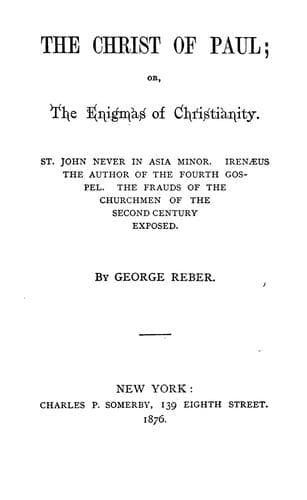
The Christ of Paul; Or, The Enigmas of ChristianityReber, George
Religion
The Christ of Paul; Or, The Enigmas of Christianity
Reber, George
Bible. New Testament -- Controversial literature; Church history -- Primitive and early church, ca. 30-600 -- Controversial literature
We have selected this place to settle a question of veracity between the
writer and Iræneus. He says he saw Polycarp. We say he never did. Since
the introduction of the Gospels, especially the fourth, great importance
has been attached to the fact that Polycarp was a disciple of John, and
that Irenaeus had been instructed by the former. Speaking of Irenaeus,
Horn, in his introduction, says: "His testimony to the genuineness and
authenticity of the New Testament is the most important and valuable,
because he was a disciple of Polycarp, who was a disciple of John."
(Vol. I. 83.) Now Polycarp never mentions John, but speaks of Paul. If
he did see John, John _never taught him the doctrine of the incarnation_
as declared in the fourth Gospel. Polycarp _never heard of the
incarnation_, and it follows as a matter of course he never taught
Irenaeus anything of the kind. _Had he taught the incarnation, he never
would have indorsed Paul_. This attempt, on the part of the so-called
Bishop of Lyons, to trace the doctrines conceived and written by himself
to a disciple, is a stupendous fraud, which has cost the world more
misery than all causes of suffering since his day combined. This Gospel
has been the means of defeating the mission of Christ on earth--_peace
and good-will to all men_. There is not one word in it to encourage
virtue or reprove vice--not one for those who sorrow or are afflicted;
no charity for any except the woman caught in adultery. Love for one
another he entreated of his disciples, but none for the world. The
boundless love, the universal charity, which shine forth in the Sermon
on the Mount, and warm the heart, so that there flows from it all that
is good in our natures--as the beautiful flowers of the earth are made
to spring and bloom under the genial heat of the sun--finds no place
in the Gospel of John. What is said and taught in this Gospel, when
compared with the teachings on the Mount, are as hollow groans from the
cavern of Avernus compared with sweet sounds from the lyre of Orpheus.
It is belief--or damnation. "He that believeth on Him is not condemned,
but he that believeth not is condemned already, because he hath not
believed in the name of the only begotten Son of God." It was this
Gospel which gave birth to that bigotry and fanaticism which has brought
on the world all the sufferings and misery caused by the Inquisition. It
destroyed in the fourth century all the grand and beautiful temples and
works of architecture of Asia and Europe. The Pantheon barely escaped.
It applied the torch to the library at Alexandria. It kindled the fires
of persecution in every age; and as it came down the centuries, like a
blazing comet, it carried with it "pestilence and war." It makes Christ
cold and selfish. He cures diseases to exalt himself. A man was deprived
of his sight from his birth, without any sin on his part, that he may
have an opportunity to make known his power. He thanks God for answering
Public-domain text, read in full here on John Shaqi.
Reviews
Reviews
No reviews yet
Be the first to share your thoughts on this work.
Elsewhere in the archive
Join the Discussion
Join the discussion
Sign in to leave a comment or review.
Sign InorCreate an account