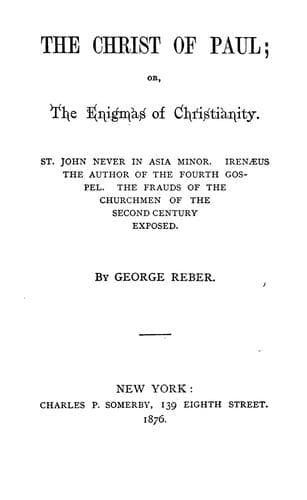
The Christ of Paul; Or, The Enigmas of ChristianityReber, George
Religion
The Christ of Paul; Or, The Enigmas of Christianity
Reber, George
Bible. New Testament -- Controversial literature; Church history -- Primitive and early church, ca. 30-600 -- Controversial literature
Whatever difference of opinion there may have been between
these two great leaders, it seemed to be merged in the creed of the
Church in the days of Polycarp and other teachers of his time. With Paul
and these men, Christ was born of woman and of the seed of David; but,
with the latter, it was by the Holy Ghost, through the providence of
God. As Paul has nowhere declared how and in what way Christ was the son
of God, but believed him to be such from what he learned in his vision
at Damascus and other places, his followers might readily accept the
belief declared by Ignatius and all the Fathers in his day. Mutual
concessions seem to have been made in the latter part of the first
century; and while the followers of Apollos conceded the descent of
Christ from David, the friends of Paul could readily admit that he was
the Son of God through the Holy Ghost by the dispensation of God. The
violent animosity against Paul which sprang up afterward in the Church
was an outgrowth of the second century. In this century, Paul becomes a
liar and a heretic. To make Christ what the men of this century wished
to have him appear in their quarrels with the Gnostics and others, it
was necessary to assail the great apostle. To admit that Christ was born
in the womb of Mary, of the seed of David, would not admit the claim
that he was conceived in the womb of Mary by the Holy Ghost alone. It
was upon this point that Paul had thrown obstructions in the way of men
who were engaged in building up a Church controlling exclusively the
highway to heaven, and which in time was to govern the world. Here let
me ask if the most acute intellect can detect in the doctrines of the
Church, as declared by Polycarp and others at the beginning of the
second century, the faintest trace of the _incarnation of the fourth
Gospel, or the Trinity_, Both of these dogmas, which have convulsed the
world for eighteen hundred years, were unborn when the Fathers of all
the churches of Asia, at Smyrna, declared what was the faith of the
Church.
Public-domain text, read in full here on John Shaqi.
Reviews
Reviews
No reviews yet
Be the first to share your thoughts on this work.
Elsewhere in the archive
Join the Discussion
Join the discussion
Sign in to leave a comment or review.
Sign InorCreate an account