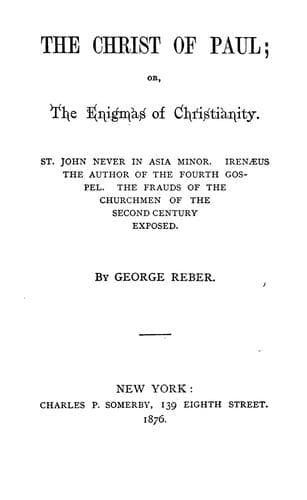
The Christ of Paul; Or, The Enigmas of ChristianityReber, George
Religion
The Christ of Paul; Or, The Enigmas of Christianity
Reber, George
Bible. New Testament -- Controversial literature; Church history -- Primitive and early church, ca. 30-600 -- Controversial literature
We have stated that at Smyrna were declared the doctrines of the
Christian Church in the year 107, as they were understood and taught by
Polycarp, Ignatius, and all the great lights of Asia. And now we shall
show what assurances these Fathers gave to the world--why they knew that
Christ was truly the Son of God. This is made manifest by signs in
the heavens. Ignatius first declares the belief of the Church on this
subject, and proceeds to ask this question: "How was he made manifest to
the world?" "A star shone in heaven above all other stars; and its light
was inexpressible, and its novelty struck terror. All the rest of the
stars, with the sun and moon, were the chorus to this star, that sent
forth its light above all. And there was trouble, whence this novelty
came so unlike all the others. Hence all the power of magic was
dissolved; and every bond of wickedness was destroyed; ignorance was
taken away and the old kingdom was abolished: God made manifest in the
form of man, for the renewal of eternal life. Thence began what God
prepared. From thenceforth all things were disturbed, forasmuch as he
designed to abolish death." (_Epistle to Ephesians_, sec. 19.) This was
the way in which Christ made himself manifest to the world, as taught in
all the churches in A.D. 107. The story of the star which led the wise
men to Bethlehem was an _afterthought_. At the time Ignatius declared
the doctrine of the Church, as to the way by which Christ was brought
into the world and how he was made manifest, the Gospel of Matthew had
not yet appeared; for, if it had, he would have given the story of the
star, and the wise men of the East, rather than that of the sun,
moon, and all the stars, for the former was the most probable and most
sensible of the two. Why should he give one story which was false and
impossible on its face, if he could give another which, if false, was
not manifestly absurd. It is quite easy to tell why the story of the
stars and moon leaving their orbits to dance attendance to a bright
particular star was abandoned. Such a commotion of the heavenly bodies
would have put the universe out of joint; and as the star projected its
light above all the other stars, and all the other stars and the moon
and sun sang chorus to it, the display would have been apparent to all
the world. In the year A.D. 107, some few might have been alive who were
living at the time the phenomenon is said to have occurred; and if not,
then the children of those who lived at the time would have preserved
the tradition fresh in their minds, to say nothing of history. But as no
one living witnessed the scene enacted in the heavens, and none of their
descendants had heard of it, and no historian had recorded it, the men
of the day laughed it down. One single star might have been seen by the
wise men of the East, and no one else; and if the story was invented,
as the wise men were dead before it was told, there was no danger of
contradiction.
Public-domain text, read in full here on John Shaqi.
Reviews
Reviews
No reviews yet
Be the first to share your thoughts on this work.
Elsewhere in the archive
Join the Discussion
Join the discussion
Sign in to leave a comment or review.
Sign InorCreate an account