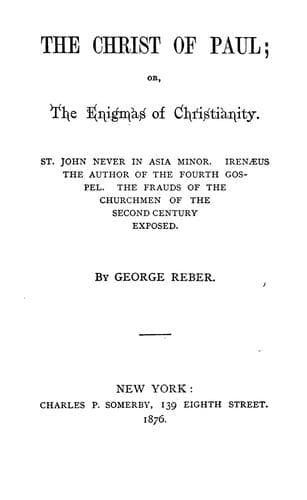
The Christ of Paul; Or, The Enigmas of ChristianityReber, George
Religion
The Christ of Paul; Or, The Enigmas of Christianity
Reber, George
Bible. New Testament -- Controversial literature; Church history -- Primitive and early church, ca. 30-600 -- Controversial literature
If the Gospel of Matthew was not extant A.D. 107, it
is fatal to all the prophecy in the New Testament as to the fall of
Jerusalem. In the year A.D. 70, Jerusalem fell. The Roman standards
waved over its ruins. The daughters of Israel wept over the ashes of
their homes. The holy city was no more, and he who wrote the Gospel of
Matthew as it now stands wrote history. How much is the Christianity of
the Gospels indebted to the prophecies which foretold the fall of the
Jewish capital? In every age and in every country where Christianity
found a foothold, they were the corner-stone of the Christian faith.
In the hour of doubt and despair, when the heavens looked black and
the earth seemed to be a house of mourning, the Christian could draw
consolation from the tears shed by Christ as he wept over the fall of
the holy city. But Truth is inexorable. Her triumphant car moves on,
though she leaves in her wake the wreck of the brightest hopes, the most
cherished creeds, and the most ambitious schemes. So she has done for
ages. And her pathway is marked by the overthrow of dogmas by which
man vainly undertook to enslave the mind. To-day she is as mighty and
powerful as ever.
APPENDIX.
(A.)
Few passages from history have given rise to more discussion than the
following from Suetonius: "He," meaning the Emperor Claudius,
"banished all the Jews, who were continually making disturbance, at the
instigation of one Crestus." (_Life of Claudius_, sec. 25.) The original
is as follows: "_Judæos, impulsore Chresto, assidue tumultuantes, Roma
expulit_." Does this order of banishment refer to the Christians? Dr.
Lardner and others think not. All difficulties vanish when we bear in
mind, that the Christians then at Rome were Jewish converts from Judea.
The writer knew little about Christians, and knowing them to be Jews, he
says all Jews were banished, which included the Jewish converts as
well as those who opposed Christianity. All engaged in the riot were
included, and none but Jews were. These Jews were constantly making
disturbance at the instigation of one Crestus: that is, they were
quarrelling about Crestus, which was a continual subject of quarrel
among the converted and unconverted Jews everywhere. The writer knew so
little about Christ that he failed to get the name correct, or there may
have been a mistake on the part of the transcribers.
(B.)
Public-domain text, read in full here on John Shaqi.
Reviews
Reviews
No reviews yet
Be the first to share your thoughts on this work.
Elsewhere in the archive
Join the Discussion
Join the discussion
Sign in to leave a comment or review.
Sign InorCreate an account