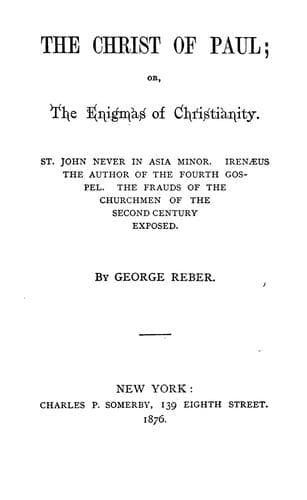
The Christ of Paul; Or, The Enigmas of ChristianityReber, George
Religion
The Christ of Paul; Or, The Enigmas of Christianity
Reber, George
Bible. New Testament -- Controversial literature; Church history -- Primitive and early church, ca. 30-600 -- Controversial literature
"Flavius Clemens, his cousin-german, a man contemptible for his
indolence, whose sons, then of tender age, he had avowedly destined for
his successor, and taking from them his former names, had ordered one
to be called Vespasian, and the other Domitian, he suddenly put to death
upon some slight suspicion, almost before the father was put out of his
consulship," (Suet, _Life of Domitian_, sec. 15.) As the tyrant affected
great reverence for the gods, he would not fail to visit the most severe
punishment on those whom he judged guilty of irreverence, and as the
Christians of that day were bold in the face of the most imminent
danger, they could not escape the vengeance of the tyrant, had there
been any in Rome upon whom he could lay his hands. With a disposition
that was willing to furnish any number of victims, Eusebius has
succeeded in giving the name of a single one. He says, "At the same
time, for professing Christ, Flavius Domitilla, the niece of Flavius
Clemens, one of the consuls of Rome at that time, was transported, with
many others, to the Isle of Pontia." (Eus., E. H., book iii. chap. 18.)
The truthful father has succeeded in giving the name of one Christian
who had suffered under the reign of Domitian, and that was a case of
banishment.
As to the expression, "and many others," it is only an easy way of
conveying a falsehood without incurring the risk of detection. The story
of John's banishment to the Isle of Pat-mos, like everything else
which relates to this Apostle, is founded on a _tradition_ of the
third century, and is unworthy of serious notice. The story told by
Hegesippus, of the treatment received by the grandchildren of Jude,
called the brother of Jesus, at the hands of Domitian, if entitled to
any credit at all, only goes to refute the charges made against him. As
the story runs, these children were brought before him on the charge
of being Christians. After hearing what they had to say, "Domitian
dismissed them--made no reply--but treating them with contempt as
simpletons, commanded them to be dismissed, and, by a decree, ordered
the persecution to cease. Thus delivered, they ruled the churches,
both as witnesses and relations of the Lord. Such is the statement of
Hegesippus," says Eusebius (book iii. chap. 20).
Here is a clear case for persecution; but proceedings are dismissed, and
those who were the objects of it treated with contempt.
Public-domain text, read in full here on John Shaqi.
Reviews
Reviews
No reviews yet
Be the first to share your thoughts on this work.
Elsewhere in the archive
Join the Discussion
Join the discussion
Sign in to leave a comment or review.
Sign InorCreate an account