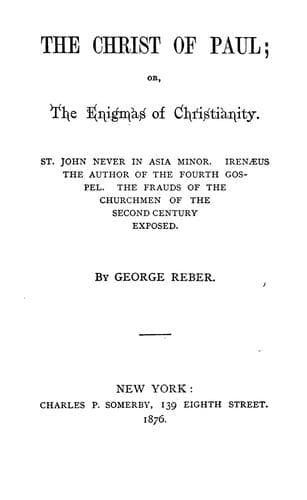
The Christ of Paul; Or, The Enigmas of ChristianityReber, George
Religion
The Christ of Paul; Or, The Enigmas of Christianity
Reber, George
Bible. New Testament -- Controversial literature; Church history -- Primitive and early church, ca. 30-600 -- Controversial literature
* The strong probability is, that the letter of Ignatius is
a forgery throughout, and was gotten up for the sake of the
introduction. Condemned by Trajan, and ordered to be carried
to Rome to be devoured by wild beasts, for the amusement of
the people, it is claimed the letter was written on his way
to that city. Why he should write to the church at Rome
while on his way there, is something remarkable, since there
is nothing in the letter that was important to be known to
the Christians, if there were any there, before his arrival.
The epistle breathes a spirit which is unnatural and
repugnant to every feeling of humanity. The following is a
specimen of the whole. "May I enjoy the wild beasts which
are prepared for me; and pray that they may be found ready
for me: which I will even encourage to devour me all at
once, and not fear to touch me, as they have some others And
if they refuse, and will not, I will compel them." (Sec. 5.)
Why would Ignatius write an epistle of this character to the
Romans while he was on the way to Rome himself? especially
"as he was pressed by the soldiers to arrive at the great
city before the public spectacle, that he might be delivered
to the wild beasts." Why import a Christian Bishop from
Antioch for the wild beasts of the Amphitheatre, if there
was one to be found in the mean time in Rome? Where was
Clement, the third Bishop? Our confidence is not increased
in the genuineness of this letter, that the first distinct
reference is made to it by Irenaeus.
(D.)
WRITERS in the third and fourth centuries, for reasons sufficiently
obvious, take pleasure in scandalizing the name of Domitian as the
persecutor of Christians, and the great enemy of the Christian cause. It
is claimed he put to death many persons accused of Atheism, the common
charge against Christians, on account of their refusal to offer incense
or to worship the ancient gods of Rome. Flavius Clemens, his cousin, is
given as an instance. Now hear what a co-temporary historian has to say
on the subject:
Public-domain text, read in full here on John Shaqi.
Reviews
Reviews
No reviews yet
Be the first to share your thoughts on this work.
Elsewhere in the archive
Join the Discussion
Join the discussion
Sign in to leave a comment or review.
Sign InorCreate an account