The Christian Creed; or, What it is Blasphemy to DenyBesant, Annie
Religion
The Christian Creed; or, What it is Blasphemy to Deny
Besant, Annie
Christianity -- Controversial literature
*THE CHRISTIAN CREED; OR, WHAT IT IS BLASPHEMY TO DENY*
_By_
*Annie Besant*
_SHOWING SOME OF THE ERRORS, CONTRADICTIONS, AND ABSURDITIES, GIVEN ON
DIVINE AUTHORITY,IN THE HOLY SCRIPTURES OF THE OLD TESTAMENT_
London
_1883_
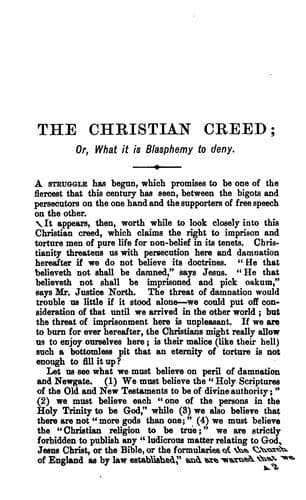
THE CHRISTIAN CREED, OR, WHAT IT IS BLASPHEMY TO DENY
A struggle has began, which promises to be one of the fiercest that this
century has seen, between the bigots and persecutors on the one hand and
the supporters of free speech on the other.
It appears, then, worth while to look closely into this Christian creed,
which claims the right to imprison and torture men of pure life for
non-belief in its tenets. Christianity threatens us with persecution
here and damnation hereafter if we do not believe its doctrines. “He
that believeth not shall be damned,” says Jesus. “He that believeth not
shall be imprisoned and pick oakum,” says Mr. Justice North. The threat
of damnation would trouble us little if it stood alone—we could put off
consideration of that until we arrived in the other world; but the
threat of imprisonment here is unpleasant. If we are to burn for ever
hereafter, the Christians might really allow us to enjoy ourselves here;
is their malice (like their hell) such a bottomless pit that an eternity
of torture is not enough to fill it up?
Let us see what we must believe on peril of damnation and Newgate. (1)
We must believe the “Holy Scriptures of the Old and New Testaments to be
of divine authority;” (2) we must believe each “one of the persons in
the Holy Trinity to be God,” while (3) we also believe that there are
not “more gods than one;” (4) we must believe the “Christian religion to
be true;” we are strictly forbidden to publish any “ludicrous matter
relating to God, Jesus Christ, or the Bible, or the formularies of the
Church of England as by law established,” and are warned that we shall
not be saved by our remarks being “intended in good faith as an argument
against any doctrine or opinion.”
(1) We must believe the Holy Scriptures of the Old and New Testament to
be of Divine Authority.
Public-domain text, read in full here on John Shaqi.
Reviews
Reviews
No reviews yet
Be the first to share your thoughts on this work.
Join the Discussion
Join the discussion
Sign in to leave a comment or review.
Sign InorCreate an account