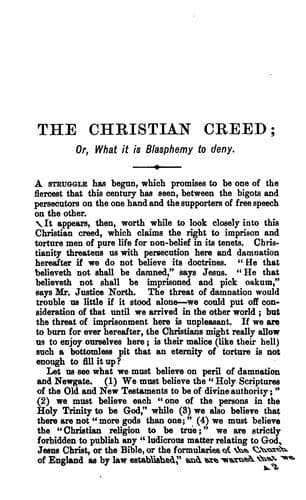
The Christian Creed; or, What it is Blasphemy to Deny — John Shaqi
The Christian Creed; or, What it is Blasphemy to DenyBesant, Annie
Religion
The Christian Creed; or, What it is Blasphemy to Deny
Besant, Annie
Christianity -- Controversial literature
It is blasphemy to deny that before Esau and Jacob were born god chose
one as his favorite, and declared: “Jacob have I loved, but Esau have I
hated” (Rom. ix., 13). If anyone should carpingly allege that it was
wrong to hate poor unborn Esau before he had committed “any good or
evil” (Rom. ix., 11), the right answer is that “god’s ways are not as
our ways,” and that which would be wickedness in man is righteousness in
god. God loved Jacob. Jacob would not give his starving brother food
until he had bargained for his birthright in return (Gen. xxv., 29—34);
but god loved Jacob. Jacob cheated his blind father, pretending to be
his brother, and deceived the old man’s sense of touch, the sense of
vision having failed (Gen. xxvii., 11, 12, 15, 16, 22, 23); but god
loved Jacob. Jacob was a hypocrite, and when he took a kid dressed to
imitate venison to his father, pretended that he had found it quickly
“because the Lord thy god brought it to me” (v. 20); but god loved
Jacob. Jacob was a liar, declaring that he was his brother Esau (v. 19,
24); but god loved Jacob. Jacob was a coward, and ran away from his
defrauded brother; but god loved Jacob. Jacob hated his wife (Gen.
xxix., 31); yet god loved Jacob. Jacob swindled his hospitable uncle
Laban out of his flocks and herds (Gen. xxx., 31-43); yet god loved
Jacob. Jacob ran away from his uncle with his ill-gotten gains, like a
thief in the night (Gen. xxxi, 20); yet god loved Jacob. Jacob was once
more a coward, afraid of the brother he had wronged, and sent on some of
his people to get killed that he might escape (Gen. xxxii., 7, 8); yet
god loved Jacob. It is instructive to know the kind of men that god
loves, and to know that god loves a bargaining, cheating, hypocritical,
lying, swindling coward. As to poor Esau, on whom fell the awful hate of
god before he was born, he seems to have been a brave, loving,
generous-hearted man. The kindly words of the man god hated, as he
refused his cringing brother’s present: “I have enough, my brother; keep
that thou hast unto thyself” (Gen. xxxiii., 9), contrast forcibly with
the mean, despicable conduct of the man god loved. It is blasphemy to
deny that god abetted pious Jacob’s frauds, for we learn that “god hath
taken away the cattle of your father, and given them to me” (Gen. xxxi.,
9), and that in suggesting the method of fraud god reminded him of the
share due to himself by the vow he had made (Gen. xxxi, 13), the said
vow being that “of all that thou shalt give me I will surely give the
tenth to thee” (Gen. xxviii., 22).
Public-domain text, read in full here on John Shaqi.
Reviews
Reviews
No reviews yet
Be the first to share your thoughts on this work.
Join the Discussion
Join the discussion
Sign in to leave a comment or review.
Sign InorCreate an account