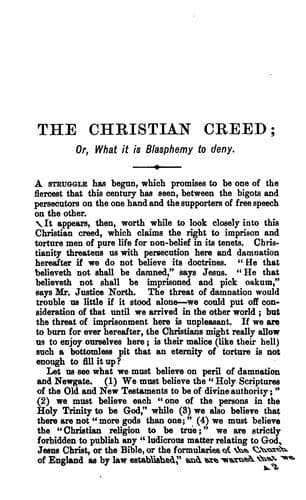
The Christian Creed; or, What it is Blasphemy to DenyBesant, Annie
Religion
The Christian Creed; or, What it is Blasphemy to Deny
Besant, Annie
Christianity -- Controversial literature
First, we must believe that “the Lord” kept on sending messages to
Pharaoh, commanding him to let the people go, while at the same time
“the Lord hardened Pharaoh’s heart, so that he would not let the
children of Israel go” (Ex. x., 20). It is blasphemy to deny that god
behaved in this horribly wicked manner, compelling Pharaoh to refuse,
and then plaguing him and his people for the refusal; we deserve
damnation if we do not agree with Paul, when he writes: “It is not of
him that willeth, nor of him that runneth, but of God that showeth
mercy. For the Scripture saith unto Pharaoh, Even for this same purpose
have I raised thee up, that I might show my power in thee, and that my
name might be declared throughout all the earth. Therefore hath he mercy
on whom he will have mercy, and whom he will he hardeneth. Thou will say
then unto me, Why doth he yet find fault, for who hath resisted his
will? Nay but, O man, who art thou that repliest against God? Shall the
thing formed say to him that formed it: Why hast thou made me thus?”
(Rom. ix., 16—20.) Yes, most certainly it should so say, if it be a
living sentient thing, capable of enjoyment and of agony. No god has the
right to create sentient beings, to harden them, and then to find fault
with them and torture them for being hardened. The challenge, “Why doth
he yet find fault?” is a very proper one, and Paul cannot answer it, so
he falls back on god’s power to do as he chooses; but the exercise of
the power would be a crime, and if it be blasphemy to say that such
unutterable wickedness is criminal, then I will blaspheme as long as I
live, rather than turn flattering courtier to a monarch more cruel than
Caligula, a despot more tyrannical than any Eastern potentate known to
history.
After the duel about the water between Moses and the Egyptian magicians
— in which the magicians certainly shewed the greater power and
dexterity—Moses and Aaron covered the land of Egypt with frogs (Ex.
viii., 6), and again the magicians proved quite as capable. Exit frogs.
Enter lice. This was too much for the magicians; “all the dust of the
land became lice” (viii., 17)—note this proof of spontaneous
generation—so the material was lacking to the magicians, but as they had
done so well in turning the water into blood after it had all become
blood already, it is disappointing to find that they broke down at this
critical period. Perhaps they were tired.
Public-domain text, read in full here on John Shaqi.
Reviews
Reviews
No reviews yet
Be the first to share your thoughts on this work.
Join the Discussion
Join the discussion
Sign in to leave a comment or review.
Sign InorCreate an account