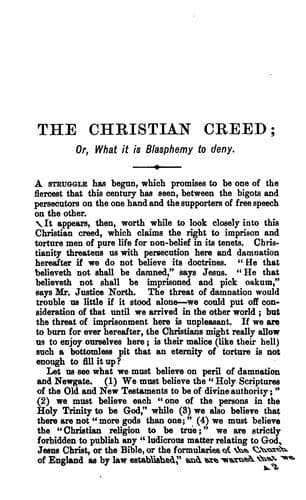
The Christian Creed; or, What it is Blasphemy to Deny — John Shaqi
The Christian Creed; or, What it is Blasphemy to DenyBesant, Annie
Religion
The Christian Creed; or, What it is Blasphemy to Deny
Besant, Annie
Christianity -- Controversial literature
The next trial to our faith is the story of the manna. The people might
well ask: “What is this?” It was so expansible and contractile that,
when they measured it, having “gathered some more, some less,” if a man
gathered much he had “nothing over, and he that gathered little had no
lack” (Ex. xvi., 17, 18). This curious result of measuring it “with an
omer” is, however, susceptible of explanation, for we read, in Ex. xvi.,
36, that “an omer is the tenth part of an ephah,” whereas, in Ezech.
xiv., the ephah contains “the tenth part of an homer.” Perhaps in
measuring some of the Jews dropped their h’s. The variable expansion of
the manna is not its only peculiarity. Manna gathered on Thursday “bred
worms and stank” if kept till Friday; manna gathered on Friday “did not
stink, neither was there any worm therein” on Saturday (xvi., 20 and
24).
The bread difficulty disposed of, the water difficulty again came to the
front, but Moses smote a rock, and water came out of it (Ex. xvii., 6).
Later, under very similar circumstances, Moses smote another rock with
the like result (Numb, xx., 11.), and the Lord was very angry with him,
and refused to let him enter “the promised land.” It is curious that in
both these cases the place was called Meribah, because of the complaints
of the Israelites; but it would be blasphemy to say that two traditions
of one incident have been inserted in the text.
Soon after this a wonderful battle took place, in which Israel fought
against Amalek, and “it came to pass when Moses held up his hand that
Israel prevailed, and when he let down his hand Amalek prevailed” (Ex.
xvii., 11). The relation of cause and effect is not clear, but it is
satisfactory to know that Moses’ hands were held up by main force until
evening stopped the slaughter.
It is blasphemy to say that there are more gods than one (Statute of
Will. III.), yet it is blasphemy to deny that “the Lord is greater than
all gods” (Ex. xviii., 11). It is hard to understand how the Lord can be
greater than gods which do not exist; nevertheless “he that believeth
not shall be damned.”
Public-domain text, read in full here on John Shaqi.
Reviews
Reviews
No reviews yet
Be the first to share your thoughts on this work.
Join the Discussion
Join the discussion
Sign in to leave a comment or review.
Sign InorCreate an account