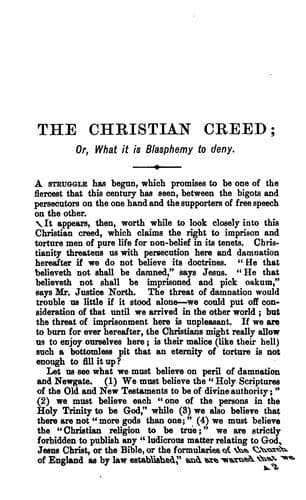
The Christian Creed; or, What it is Blasphemy to DenyBesant, Annie
Religion
The Christian Creed; or, What it is Blasphemy to Deny
Besant, Annie
Christianity -- Controversial literature
And as though to show that this book is of purely human origin, with the
mingled good and evil inseparable from all early efforts at legislation,
we read, after the foregoing horrors the following noble and generous
teaching:
“Thou shalt not raise a false report: put not thine hand with the wicked
to be an unrighteous witness. Thou shalt not follow a multitude to do
evil; neither shalt thou speak in a cause to decline after many to wrest
judgment. Neither shalt thou countenance a poor man in his cause.
If thou meet thine enemy’s ox or his ass going astray, thou shalt surely
bring it back to him again. If thou see the ass of him that hateth thee
lying under his burden, and wouldest forbear to help him, thou shalt
surely help with him. Thou shalt not wrest the judgment of thy poor in
in his cause. Keep thee far from a false matter; and the innocent and
righteous slay thou not: for I will not justify the wicked. And thou
shalt take no gift: for the gift blindeth the wise, and perverteth the
words of the righteous. Also thou shalt not oppress a stranger: for ye
know the heart of a stranger, seeing ye were strangers in the land of
Egypt.” (xxiii., 1—9.)
Here we see the pen of some lofty and tender lawgiver, who has nothing
in common with the savage chief who “breathed out threatenings and
slaughter.”
It is blasphemy to deny that the Lord on Mount Sinai gave a number of
frivolous commands, about a candlestick (Ex. xxv., 31—39) with its
snuff-dishes, and curtains, and hangings, and dresses, with their
trimmings of “a golden bell and a pomegranate, a golden bell and a
pomegranate, upon the hem,” and “holy ointment,” and “perfume,” etc.,
etc. (Ex. xxv.—xxx.). After the making of stars and suns it seems but
poor work to give directions about “loops,” and “taches,” and a “curious
girdle,” fitter employment for a cabinet maker and a tailor than for a
god with “thunders and lightnings, and a thick cloud upon the mount, and
the voice of the trumpet exceeding loud.” While Moses and the Lord were
discoursing on upholstery the people were getting into trouble down
below, and god, who is “without passions,” (Art. 1) felt his wrath “wax
hot against them” (Ex. xxxii., 10). Moses did not ask for forgiveness on
the ground of god’s goodness, but he appealed to his vanity, and
reminded him that the Egyptians would crow over him if he destroyed his
own people (xxxii., 12.) Thereupon god, who is not a man “that he should
repent” (Numb, xxiii., 19), “repented of the evil which he thought to
do” (Ex. xxxii., 14). God who is “without body” (Art 1) had written two
tables with his “finger” (Ex. xxxi., 18), and these tables “were the
work of god, and the writing was the writing of god” (xxxii, 16). So
careless was Moses of this unique specimen that he lost his temper and
broke it in pieces, and then, arriving at the camp, he sent the sons of
Levi through the camp, bidding them “slay every man his brother, and
Public-domain text, read in full here on John Shaqi.
The Christian Creed; or, What it is Blasphemy to Deny — John Shaqi
Reviews
Reviews
No reviews yet
Be the first to share your thoughts on this work.
Join the Discussion
Join the discussion
Sign in to leave a comment or review.
Sign InorCreate an account